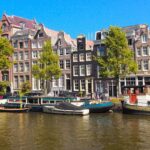
Plan your visit with our complete Amsterdam travel guide featuring top sights, itineraries, and local travel tips.
A place worth knowing
Montelbaanstoren
Historical landmarks · Tower in AmsterdamUpdated
- Google rating4.5/5 (3,000 reviews)
- Typical visit15-30 minutes for exterior viewing and photography
- EntranceAdmission required — check https://www.iamsterdam.com/ for tickets

Why it matters
A 16th-century defensive tower on the Oudeschans canal, later topped with a decorative clock spire by Hendrick de Keyser — one of Amsterdam's most photographed canal-side landmarks, best seen from a boat.
A historic 16th-century tower on the Oudeschans canal, originally built as part of the city defenses. Known for its decorative octagonal top and spire added by Hendrick de Keyser in 1606, it is a beloved landmark often called “Malle Jaap”.
Story and significance
About
A historic 16th-century tower on the Oudeschans canal, originally built as part of the city defenses. Known for its decorative octagonal top and spire added by Hendrick de Keyser in 1606, it is a beloved landmark often called “Malle Jaap”.
Historical significance
The Montelbaanstoren holds considerable historical significance as a symbol of Amsterdam’s defensive and urban development during pivotal periods in Dutch history. Initially constructed in 1516 amid growing threats from rival powers, the tower was a critical component of the city’s fortifications, reflecting the strategic importance of Amsterdam as a burgeoning trade hub. Its transformation in 1606 by Hendrick de Keyser coincided with the Dutch Golden Age, when Amsterdam emerged as a global center of commerce, culture, and innovation. The tower’s evolution from a purely military structure to a decorative civic landmark encapsulates broader historical shifts from conflict to prosperity. Throughout its existence, the Montelbaanstoren witnessed key events such as the Eighty Years’ War, which led to Dutch independence, and the expansion of Amsterdam’s canal system that facilitated economic growth. The tower’s survival through periods of war, occupation, and modernization underscores its resilience and the city’s commitment to preserving its heritage. Historically, the Montelbaanstoren has also served as a navigational aid for ships entering the city’s canals, linking it to Amsterdam’s maritime legacy. Its enduring presence has influenced the historical narrative of Amsterdam, representing the intersection of defense, commerce, and urban identity. As a result, the Montelbaanstoren remains a vital historical monument that embodies the legacy of Amsterdam’s rise as a major European capital.
Historical context
The Montelbaanstoren was originally built in 1516 as a defensive watchtower, part of Amsterdam’s city walls designed to protect the city from external threats during a period of frequent conflict and territorial expansion in the Low Countries. Its name derives from the Spanish word ‘montelbaan,’ meaning ‘mountain of war,’ reflecting the turbulent era of the early 16th century when the Netherlands was under Habsburg rule. In 1606, the tower was redesigned and heightened by architect Hendrick de Keyser, who added the distinctive ornamental spire and clock, transforming it into a more decorative structure while retaining its strategic purpose. Over the centuries, the Montelbaanstoren witnessed Amsterdam’s transformation from a fortified medieval town into a bustling center of commerce and culture during the Dutch Golden Age. The tower’s role diminished as the city expanded and modernized its defenses, but it remained a significant landmark. The Montelbaanstoren also survived various historical upheavals, including the French occupation in the late 18th century and the industrialization of the 19th century, which reshaped Amsterdam’s urban fabric. Today, it stands as a testament to the city’s layered history, encapsulating key historical developments from military architecture to civic pride. Its endurance through centuries of change highlights Amsterdam’s ability to preserve its heritage while adapting to the demands of modern urban life.
Cultural context
The Montelbaanstoren holds a distinctive place within Amsterdam’s cultural landscape, reflecting the city’s deep-rooted connection to its maritime and defensive heritage. Originally constructed in 1516 as part of the city’s medieval fortifications, the tower has evolved from a purely military structure into an emblem of Amsterdam’s resilience and historical continuity. Locally, the Montelbaanstoren is often associated with the vibrant canal life that defines Amsterdam’s urban identity. Its proximity to the Oudeschans canal situates it within a network of waterways that have historically supported trade, transport, and social interaction, making it a silent witness to centuries of cultural exchange. The tower is featured in local art, literature, and folklore, symbolizing both protection and the passage of time. During Amsterdam’s annual celebrations, such as King’s Day and the Canal Festival, the Montelbaanstoren’s silhouette is frequently admired as part of the city’s historic skyline, reinforcing its role as a cultural landmark. Moreover, the tower’s image appears in various cultural products, including paintings by Dutch Golden Age artists and contemporary photography, underscoring its enduring presence in the collective memory of Amsterdam’s residents and visitors alike. The Montelbaanstoren thus serves as a cultural touchstone, embodying the interplay between Amsterdam’s past and present traditions and continuing to inspire local pride and identity.
Architecture
The Montelbaanstoren is an exemplary fusion of late medieval military architecture and early 17th-century Dutch Renaissance design. Originally constructed as a simple brick watchtower, its robust, square base exemplifies the pragmatic defensive style of the early 1500s, characterized by thick walls and minimal ornamentation intended to withstand attacks. The tower’s most striking architectural feature was added in 1606 by Hendrick de Keyser, a prominent Dutch architect known for his contributions to Amsterdam’s skyline. De Keyser introduced an elegant octagonal spire and ornate clock face, integrating Renaissance aesthetics with functional urban elements. This combination of fortification and ornamentation reflects a transition in architectural priorities as Amsterdam shifted from a focus on military defense to civic pride and urban beautification. The use of red brick and natural stone accents is typical of Dutch Renaissance architecture, while the spire’s intricate detailing, including gilded elements and carved wooden features, showcases craftsmanship of the period. The Montelbaanstoren’s design also incorporates practical features such as narrow windows and a sturdy foundation suited to Amsterdam’s canal-rich environment. Its architectural evolution mirrors the broader trends in Dutch urban development during the 16th and 17th centuries, making it a valuable example of how functional structures were adapted to reflect cultural and aesthetic values. The tower remains a significant architectural landmark within Amsterdam’s historic cityscape.
Local significance
For Amsterdam residents, the Montelbaanstoren is more than a historic monument; it is a cherished symbol of local heritage and identity. Situated in the heart of the city’s canal district, the tower is a familiar landmark that anchors the community’s sense of place. It is often referenced in local stories and legends, including tales about its role in guarding the city against invaders and its transformation from a military outpost to a peaceful emblem of Amsterdam’s golden era. The tower’s presence enriches the daily lives of those living and working nearby, providing a tangible connection to the city’s layered history amid modern urban life. Community events and festivals frequently highlight the Montelbaanstoren as part of Amsterdam’s cultural fabric, with local guides and historians sharing its stories with residents and visitors alike. The tower’s silhouette is a common motif in neighborhood art and photography, reflecting its integration into the collective imagination of the city. Moreover, the Montelbaanstoren contributes to the local economy by attracting cultural tourism, which supports nearby businesses and encourages the preservation of the historic canal district. Its enduring visibility along the Oudeschans canal serves as a reminder of Amsterdam’s resilience and adaptability, reinforcing a shared sense of pride among locals. The Montelbaanstoren thus remains a vital and beloved part of Amsterdam’s community life.
Make the most of it
Local tips
- Visit during weekdays for fewer crowds
- Check for combo tickets with nearby attractions
- Gift shops have unique souvenirs
- Late night openings often have special events
- Members get free entry and skip lines
- Museum cafes frequently serve quality local food
- Special exhibitions require separate tickets
Hidden gems nearby
- Hidden courtyards ideal for photos
- Lesser-known wings have amazing collections
- Rooftop terraces often have great city views
- Staff recommendations for must-see pieces
- Secret passages between galleries
- Archive rooms sometimes open for special tours
- Free guided tours at specific times
Special features
- One of the Montelbaanstoren’s most unique characteristics is its distinctive octagonal spire, which was added during the 1606 renovation and serves as a visual focal point on Amsterdam’s Oudeschans canal. This spire is not only decorative but also functional, housing a clock that historically helped regulate daily life in the surrounding neighborhoods. The tower’s robust brick construction, combined with the delicate detailing of the spire, creates a striking contrast that exemplifies the blend of military utility and Renaissance artistry. Another notable feature is the tower’s location directly on the canal edge, which allowed it to serve as a vantage point for monitoring both land and water traffic, an essential function during Amsterdam’s rise as a major port city. Internally, the Montelbaanstoren contains narrow staircases and small chambers that reflect its original defensive purpose, offering visitors a tangible connection to the past. The tower’s integration with the surrounding canal infrastructure is also remarkable, as it forms part of a complex network of waterways and fortifications that protected the city. Additionally, the Montelbaanstoren has inspired numerous artists and photographers due to its picturesque setting and historical ambiance, contributing to its status as a cultural icon. Its ability to function as both a historic monument and a living part of Amsterdam’s urban environment makes it a particularly special feature of the city’s architectural heritage.
How we rate it
Authenticity9/10
Accessibility score8/10
Family-friendly score8/10
Off-the-beaten-path6/10
Editorial scores on a 10-point scale, judged against places of the same kind.
Worth booking ahead in Amsterdam
Hand-picked from the operators our guides already send readers to. Prices and availability are live on the partner site.
Timed ticketGetYourGuide
Van Gogh Museum timed-entry ticket (opens GetYourGuide in a new tab)
The museum sells timed slots online only, so book the hour first and plan the rest of the day around it.
Guided tourGetYourGuide
Life of Anne Frank and Jewish Quarter walking tour (opens GetYourGuide in a new tab)
The house itself sells tickets only through its own site; this walk covers the Jewish Quarter and the story around it.
CruiseGetYourGuide
Pancake Boat: 75-minute IJ river cruise (opens GetYourGuide in a new tab)
A 75-minute cruise on the IJ with unlimited Dutch pancakes on board; the easiest boat trip to sell to children.
Where to stayBooking.com
Stays in Amsterdam (opens Booking.com in a new tab)
Live rates and availability for Amsterdam on Booking.com; filter by neighbourhood once you know where your days start.
We earn a commission if you book through these links, at no extra cost to you. It is how we keep the guides free and independent.







Where to find it
- Address
- Oudeschans 2, 1011 KX Amsterdam, Netherlands
- Map
- Open in Maps ↗ Directions ↗ Verified location
- Coordinates
- 52.3721, 4.9057
- Destination
- Amsterdam