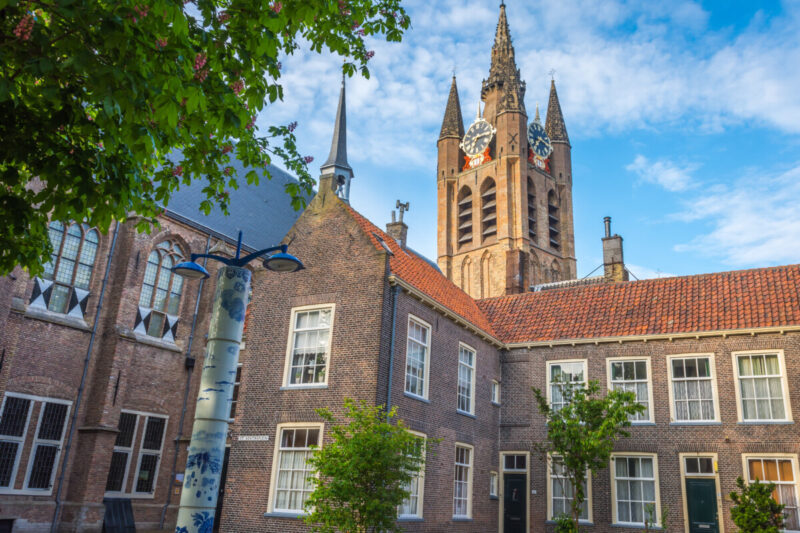
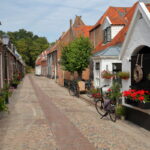
Delft distinguishes itself among Dutch cities through its exceptional preservation of Golden Age architecture and its centuries-old association with Delftware ceramics, those iconic blue and white pottery pieces that became synonymous with Dutch culture worldwide. Founded around a canal in the 11th century, this university town between Rotterdam and The Hague grew into an important trading center whose wealth manifested in its monumental buildings—the Gothic Oude Kerk (Old Church) with its leaning tower and the Renaissance-styled Nieuwe Kerk (New Church) where members of the Dutch royal family are entombed. The city’s intimate scale allows visitors to appreciate its harmonious urban planning, with canals lined by step-gabled merchants’ houses and peaceful hofjes (almshouse courtyards). Delft’s most famous resident, the painter Johannes Vermeer, captured the city’s luminous quality in works like “View of Delft,” though few of his paintings remain in his hometown. The city’s pottery tradition began in the 17th century when local craftsmen created faience inspired by Chinese porcelain, establishing workshops where visitors today can observe artisans continuing these labor-intensive techniques at Royal Delft, the last remaining factory of the original 32. Delft Technical University, the country’s oldest and largest technical university, brings youthful energy and innovation to this historic setting, creating a blend of tradition and cutting-edge research. The Markt (market square) serves as the city’s living room, where the impressive Renaissance-style City Hall faces cafes with outdoor terraces, hosting the weekly market every Thursday. Throughout its compact historic center, Delft offers an intimate, authentic Dutch urban experience, where bicycles outnumber cars, canal reflections double architectural beauty, and the atmosphere retains an artistic sensibility connected to its creative past.
The destination guide
Delft

City in Netherlands, EuropeUpdated
- Overall7/10
- Best forBudget travelers
- CurrencyEUR
Delft is Vermeer’s hometown and the birthplace of Delft Blue pottery — a small Dutch city where the canals are quiet, the Nieuwe Kerk towers over the market square, and the ceramics are still hand-painted.
Travel guides for Delft
Itineraries & day trips (1)
Things to do (1)
More guides featuring Delft (11)
At a glance
- Dutch
- English
- Canal city
- Blue pottery heritage
- Historic center
- Dutch Golden Age
- History
- Art
- Architecture
- Culture
- Ceramics
How Delft scores
Character
Editorial scores on a 10-point scale, weighed against destinations of the same kind.
Travel safety snapshot
SafePlace indicators use their source 100-point scale; higher is more favourable. Planning context, not a live travel advisory — check official government guidance before you go.
When to go
Best months to visit: April, May, June, July, August, September and October.
- January: 2.4 to 6.9 degrees Celsius, 82.7 millimetres of rain, best-time score 2 out of 5.
- February: 2.7 to 8.2 degrees Celsius, 68.4 millimetres of rain, best-time score 2 out of 5.
- March: 3.4 to 10.6 degrees Celsius, 67.9 millimetres of rain, best-time score 3 out of 5.
- April: 5.6 to 13.6 degrees Celsius, 57.9 millimetres of rain, best-time score 5 out of 5.
- May: 9.2 to 17.5 degrees Celsius, 69.2 millimetres of rain, best-time score 5 out of 5.
- June: 13.1 to 20.9 degrees Celsius, 69.9 millimetres of rain, best-time score 5 out of 5.
- July: 14.4 to 21.8 degrees Celsius, 76.3 millimetres of rain, best-time score 4 out of 5.
- August: 14.9 to 22.3 degrees Celsius, 76.9 millimetres of rain, best-time score 4 out of 5.
- September: 12.4 to 19.7 degrees Celsius, 84.9 millimetres of rain, best-time score 5 out of 5.
- October: 9.9 to 15.4 degrees Celsius, 103 millimetres of rain, best-time score 5 out of 5.
- November: 5.5 to 10.4 degrees Celsius, 87.5 millimetres of rain, best-time score 3 out of 5.
- December: 3.7 to 7.9 degrees Celsius, 83 millimetres of rain, best-time score 3 out of 5.
Month-by-month conditions and packing advice
- January
- Cold, some rain January in Delft: cold winter conditions make walking-heavy plans less balanced. Crowds: January in Delft is workable with normal seasonal planning; build in layers, weather checks, and a mix of indoor and outdoor activities. Pack: Pack warm layers, a coat, and comfortable shoes for cold mornings and evenings. Add a rain jacket or compact umbrella.
- February
- Cold, occasional rain February in Delft: cold winter conditions make walking-heavy plans less balanced. Crowds: February in Delft is workable with normal seasonal planning; build in layers, weather checks, and a mix of indoor and outdoor activities. Pack: Pack warm layers, a coat, and comfortable shoes for cold mornings and evenings.
- March
- Cool to mild, occasional rain March in Delft: cooler or wetter weather shifts the visit toward museums, cafes, and indoor sights. Crowds: March in Delft is workable with normal seasonal planning; build in layers, weather checks, and a mix of indoor and outdoor activities. Pack: Pack layered clothing and comfortable walking shoes.
- April
- Cool to mild, occasional rain April in Delft: canals, Vermeer sights, markets, terraces, bike rides, and nearby city trips are most comfortable. Crowds: April in Delft is workable with normal seasonal planning; build in layers, weather checks, and a mix of indoor and outdoor activities. Pack: Pack layered clothing and comfortable walking shoes.
- May
- Cool to mild, occasional rain May in Delft: canals, Vermeer sights, markets, terraces, bike rides, and nearby city trips are most comfortable. Crowds: May in Delft is workable with normal seasonal planning; build in layers, weather checks, and a mix of indoor and outdoor activities. Pack: Pack layered clothing and comfortable walking shoes.
- June
- Mild to warm, occasional rain June in Delft: canals, Vermeer sights, markets, terraces, bike rides, and nearby city trips are most comfortable. Crowds: June in Delft is comfortable for sightseeing, neighborhoods, food stops, day trips, and outdoor time with limited weather friction. Pack: Pack layered clothing and comfortable walking shoes.
- July
- Mild to warm, some rain July in Delft: summer has long days and lively streets, though it can be busier. Crowds: July in Delft is workable with normal seasonal planning; build in layers, weather checks, and a mix of indoor and outdoor activities. Pack: Pack layered clothing and comfortable walking shoes. Add a rain jacket or compact umbrella.
- August
- Mild to warm, some rain August in Delft: summer has long days and lively streets, though it can be busier. Crowds: August in Delft is workable with normal seasonal planning; build in layers, weather checks, and a mix of indoor and outdoor activities. Pack: Pack layered clothing and comfortable walking shoes. Add a rain jacket or compact umbrella.
- September
- Cool to mild, some rain September in Delft: canals, Vermeer sights, markets, terraces, bike rides, and nearby city trips are most comfortable. Crowds: September in Delft is workable with normal seasonal planning; build in layers, weather checks, and a mix of indoor and outdoor activities. Pack: Pack layered clothing and comfortable walking shoes. Add a rain jacket or compact umbrella.
- October
- Cool to mild, some rain October in Delft: canals, Vermeer sights, markets, terraces, bike rides, and nearby city trips are most comfortable. Crowds: October in Delft is workable with normal seasonal planning; build in layers, weather checks, and a mix of indoor and outdoor activities. Pack: Pack layered clothing and comfortable walking shoes. Add a rain jacket or compact umbrella.
- November
- Cool to mild, some rain November in Delft: cooler or wetter weather shifts the visit toward museums, cafes, and indoor sights. Crowds: November in Delft is workable with normal seasonal planning; build in layers, weather checks, and a mix of indoor and outdoor activities. Pack: Pack layered clothing and comfortable walking shoes. Add a rain jacket or compact umbrella.
- December
- Cold, some rain December in Delft: cooler or wetter weather shifts the visit toward museums, cafes, and indoor sights. Crowds: December in Delft is workable with normal seasonal planning; build in layers, weather checks, and a mix of indoor and outdoor activities. Pack: Pack layered clothing and comfortable walking shoes. Add a rain jacket or compact umbrella.
Know before you go
Best time to visit
Spring (April-May) and Autumn (September-October)
Season by season
Spring (Apr–May): mild weather, tulips blooming, moderate crowds—ideal for canal-side strolling. Summer (Jun–Aug): warmest weather, canal-side terraces, peak tourist season. Autumn (Sep–Oct): pleasant temperatures, golden fall colors along the canals, fewer visitors. Winter (Nov–Mar): quieter and colder, festive December atmosphere with holiday lights and markets.
Crowds
Moderate (busy in summer, manageable spring/autumn, quiet in winter)
Getting there and around
Getting there
Fly into Amsterdam Schiphol Airport (AMS, 45 min by direct train) or Rotterdam The Hague Airport (RTM, then bus + train ~45 min). From Amsterdam Centraal, direct trains reach Delft in about 50 minutes. From Rotterdam Centraal, trains arrive in just 12 minutes. The Hague is 15 minutes by train. Delft station sits a 5-minute walk from the historic center.
Getting around
Delft’s compact medieval center is best explored on foot—most attractions lie within a 15-minute walk of the Markt square. Rent a bicycle from local shops for a truly Dutch experience. Stagecoach buses and trams connect to nearby cities. For regional travel, purchase an OV-chipkaart for seamless use on trains, trams, and buses. Taxis are available but rarely needed within the center.
Top experiences in Delft
Nieuwe Kerk (New Church)
A Gothic landmark on the Markt square serving as the royal burial site for the Dutch Royal Family. Climb the 376-step, 108-meter tower for panoramic views stretching to Rotterdam and The Hague.
Royal Delft (De Porceleyne Fles)
The last remaining original Delftware factory, operating since 1653. Tour the workshop to watch master painters hand-craft the iconic blue-and-white pottery and explore galleries of historic pieces.
Museum Prinsenhof Delft
Housed in a former monastery, this museum covers Delft’s history, its connection to William of Orange (assassinated on the premises in 1584), and masterpieces by Delft’s Golden Age painters.
Oude Kerk (Old Church)
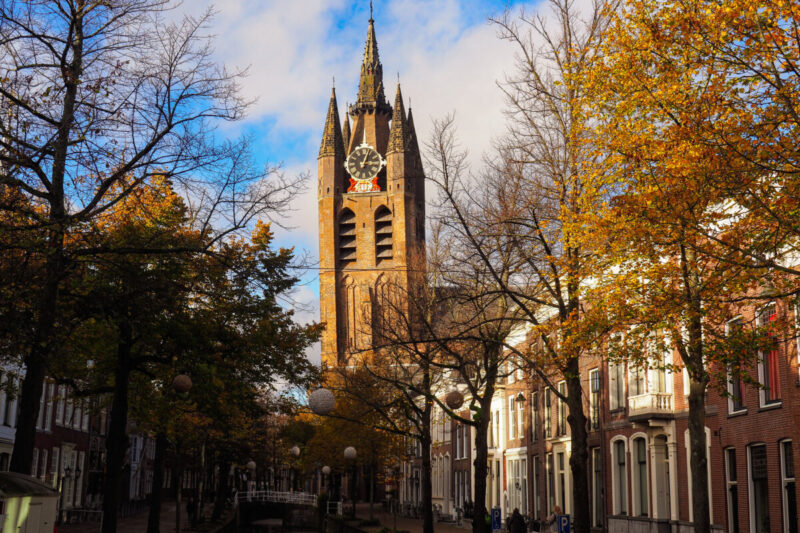
Nearly 800 years old, this Gothic church features a distinctive leaning tower and houses the tomb of Johannes Vermeer along with an impressive 15th-century bell tower.
Oostpoort (Eastern Gate)
The only surviving medieval city gate, dating from the 15th century. Its twin towers in Brick Gothic style frame one of Delft’s most photographed canal views.
Editor-curated picks carried over from our original guide. Where a full place guide exists, the card links to it.

Worth booking ahead in Delft
Hand-picked from the operators our guides already send readers to. Prices and availability are live on the partner site.
Timed ticketGetYourGuide
Van Gogh Museum timed-entry ticket (opens GetYourGuide in a new tab)
The museum sells timed slots online only, so book the hour first and plan the rest of the day around it.
Day tripViator
Giethoorn day trip with village boat tour (opens Viator in a new tab)
Coach out, guided boat through the village, and back the same day without working out the train-and-bus connection.
Where to stayBooking.com
Stays in Delft (opens Booking.com in a new tab)
Live rates and availability for Delft on Booking.com; filter by neighbourhood once you know where your days start.
We earn a commission if you book through these links, at no extra cost to you. It is how we keep the guides free and independent.
Where to stay
Hotel Johannes Vermeer
Editor-curated stays carried over from our original guide. Where we have reviewed the hotel, the card links to the review.
Tips from the field
Highlights
- Nieuwe Kerk – Royal burial church with panoramic tower views
- Royal Delft Factory – Last original Delftware pottery workshop
- Museum Prinsenhof – William of Orange assassination site
- Canal-lined medieval center – Vermeer's inspiration
- Oostpoort – 15th-century medieval city gate
Best activities
- Climb the 376-step Nieuwe Kerk tower for panoramic views to Rotterdam and The Hague, tour the Royal Delft factory to see master painters hand-crafting Delftware, explore Museum Prinsenhof where William of Orange was assassinated, cruise the canals by boat, wander the Markt square on Thursday market day, visit the Vermeer Centrum Delft, and discover hidden hofjes (historic courtyards).
Local experiences
- Watch master painters hand-decorate Delft Blue pottery at the Royal Delft factory, or take a guided canal tour to hear stories of Vermeer and the Golden Age from the water.
Practical tips
- Cashless Society: The Netherlands is nearly cashless—bring a debit and credit card. Some shops (e.g., Albert Heijn) only accept Dutch debit cards.
- Bike Lanes: Stay out of bike lanes at all times—cyclists have absolute priority.
- Thursday Market: The Markt hosts an open-air market every Thursday with produce, cheese, and flowers.
- Train Connections: Rotterdam is 12 minutes and The Hague 15 minutes by train—making Delft a perfect base for day trips.
- Museum Card: A Museumkaart provides free entry to 400+ museums across the country.
- Respect Dinner Time: Don't drop in on Dutch people unannounced around 6 PM—it's family dinner hour.
Photography tips
- The Markt square with Nieuwe Kerk and the Renaissance City Hall provides Delft's signature composition. Canals flanked by 17th-century townhouses are best captured in morning light when reflections are sharpest. The leaning tower of the Oude Kerk makes for a quirky architectural shot. Hidden courtyards like Hofje van Pauw offer intimate, crowd-free settings. Shoot the Oostpoort gate from the canal bridge for a classic Dutch scene with reflections.
Timing
- A single full day covers the Markt, Nieuwe Kerk tower, Museum Prinsenhof, and Royal Delft factory. Two days allow for canal cruising, hidden courtyard exploration, and a day trip to The Hague or Rotterdam.
Keeping it authentic
- Delft's identity is rooted in three pillars: its 17th-century Golden Age prosperity (when Vermeer painted and Delftware became world-famous), its role as the birthplace of the Dutch Republic (William of Orange's assassination in 1584 sparked independence), and its modern university culture (TU Delft is a top technical institution). The blue-and-white pottery tradition continues in the same factory since 1653, and the medieval street grid Vermeer painted remains largely intact.
Culture, customs and safety
Cultural heritage
Delft preserves its Golden Age heritage as the Netherlands’ ceramic capital where Royal Delft manufactory maintains hand-painting traditions since 1653. The distinctive blue and white pottery, originally imitating Chinese porcelain, became uniquely Dutch through windmill and tulip motifs. William of Orange’s assassination site in the Prinsenhof shows bullet holes from 1584, while his tomb in the Nieuwe Kerk anchors royal connections. Vermeer’s legacy permeates the city where he painted “View of Delft” and “Girl with a Pearl Earring.” Traditional Dutch markets sell local cheese and flowers in the historic Markt square. The city’s intact medieval street plan includes hidden hofjes (courtyard almshouses) providing tranquil gardens behind modest doorways.
Local customs & etiquette
The Dutch value directness—expect honest, straightforward conversations without small talk. Punctuality is essential; arrive on time or notify in advance. Greet each person individually with a firm handshake and direct eye contact. Personal space is respected; avoid physical contact in crowds. Split bills at restaurants unless someone explicitly offers to pay. Bicycle culture is paramount—never walk in bike lanes.
Safety notes
Delft is one of the safest cities in the Netherlands with a low crime rate. Petty pickpocketing can occur in busy tourist areas—keep personal belongings secure. Watch out for bicycle lanes, as cyclists have right-of-way and expect clear paths. Canal edges lack guardrails in places, so exercise caution at night. Public transport is reliable and safe.