Oia (pronounced EE-ah) sits at the northern tip of Santorini, perched on the rim of one of the world’s largest volcanic calderas. The village stretches along a narrow ridge of the Aegean island, its whitewashed Cycladic architecture punctuated by cobalt-blue church domes and deep-cut cave dwellings known as yposkafa. Oia draws visitors from across the globe and is consistently ranked among the most photographed villages in the Mediterranean.
What is Oia known for?
Oia is best known for its caldera-edge sunset views, traditionally watched from the ruins of the Venetian-era Oia Castle (Kasteli) at the village’s western end, where crowds gather nightly to see the sun drop into the Aegean Sea. The village is equally famous for its yposkafa cave houses—residences and boutique hotels hewn directly into the volcanic cliffside—and for its concentration of blue-domed churches, including the iconic Three Bells of Fira-style cupolas visible from the main pedestrian lane, Nikolaou Nomikou Street.
Best things to do in Oia
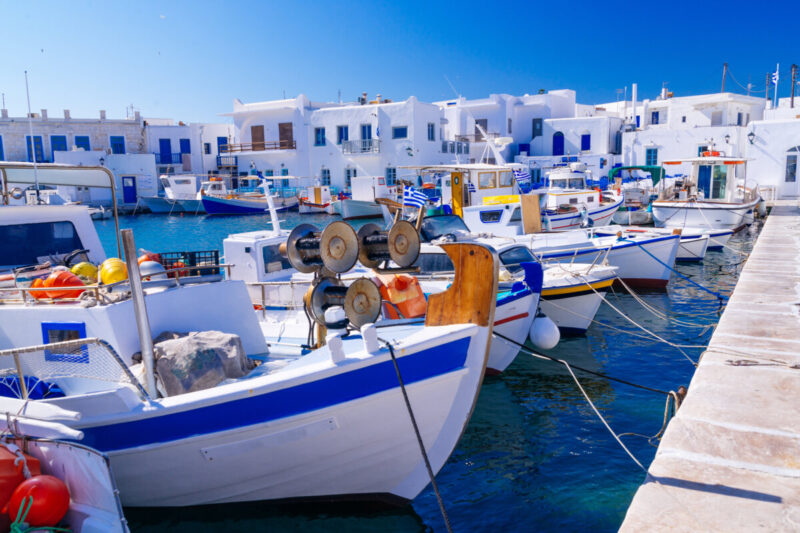
Walking the length of Nikolaou Nomikou Street, the car-free main pedestrian artery, reveals galleries, jewelry workshops, and views over the caldera at nearly every turn. Key experiences include visiting the Naval Maritime Museum of Oia, which documents Santorini’s shipbuilding and seafaring history, and descending the 300-plus steps of the Oia-to-Ammoudi path to reach Ammoudi Bay, a working fishing port where small boats dock beside volcanic rock. The windmills at the eastern approach to the village mark the boundary with the agricultural plateau and are a recognized photographic landmark.
- Watch sunset from the Oia Castle ruins (Kasteli)
- Explore the Naval Maritime Museum of Oia
- Walk down to Ammoudi Bay for fresh seafood
- Browse the art galleries along Nikolaou Nomikou Street
- Photograph the Three Bells of Fira-style blue-domed church
Where to eat in Oia
Oia’s dining scene concentrates along Nikolaou Nomikou Street and down at Ammoudi Bay, where tavernas serve grilled octopus, fresh sea bream, and local Santorinian fava—a yellow split-pea purée distinct to the island—alongside tomatokeftedes (tomato fritters) made from the island’s small, sweet cherry tomatoes. The village is also known for its upscale caldera-view restaurants offering Aegean cuisine with menus built around local white Assyrtiko wine, produced from grapes grown in the island’s volcanic soil.
- Ammoudi Bay tavernas: grilled octopus and sea bream
- Local fava (yellow split-pea purée) and tomatokeftedes
- Assyrtiko white wine from Santorinian volcanic vineyards
- Caldera-view fine dining along Nikolaou Nomikou Street
How to get to Oia
Oia is accessible from Fira, Santorini’s capital, via the island’s KTEL public bus network, with buses running regularly along the main road connecting the two villages in approximately 25–30 minutes; the bus stop in Oia sits at the eastern edge of the village near the parking area. Taxis and private transfers from Santorini’s Thira (Fira) central taxi stand or from Santorini International Airport (JTR) are widely available. Many visitors also arrive by catamaran or sailing tour from Athinios Port, anchoring at Ammoudi Bay below the village.
Where to walk in Oia
The primary walking route runs the full length of Nikolaou Nomikou Street from the Oia bus terminal eastward through the village core to the Kasteli sunset point at the western cliff edge, a flat pedestrian path of roughly 1.5 kilometers. A second route descends from the village center via stone-cut steps to Ammoudi Bay, passing cave-house facades and offering direct caldera and Thirassia island views throughout the descent.
Best time to visit Oia
Late April through early June and September through October offer the most favorable conditions in Oia, with warm temperatures, caldera visibility unobscured by summer haze, and significantly smaller crowds than the July–August peak season when the village’s narrow lane can become severely congested around sunset. Visiting the Kasteli viewpoint at sunrise rather than sunset is a practical alternative during high season that delivers comparable light and dramatically fewer visitors.