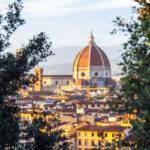
The largest masonry dome ever constructed, crowning Florence's cathedral with a 463-step climb to a panoramic terrace at 91 metres, completed by Filippo Brunelleschi in 1436 using an innovative double-shell design without centring.
The construction of Brunelleschi’s dome in Florence, Italy, was a significant engineering and architectural achievement of the Renaissance period, showcasing the innovative techniques and advancements of the time.
Brunelleschi’s dome is the largest brick dome in the world. It remains an iconic symbol of Florence and Renaissance culture, enchanting the world since its creation.
The dome’s influence extends globally. Its architectural and engineering principles serve as a touchstone for subsequent dome constructions and inspire admiration and study by architects and engineers worldwide. Efforts to preserve and maintain the dome reflect its enduring historical and cultural significance, with ongoing conservation work ensuring its longevity and continued ability to captivate visitors.
- Cultural Authenticity: The Florence Cathedral, including Brunelleschi’s Dome, maintains and represents local traditions and cultural practices through its historical significance and architectural preservation, reflecting the heritage of Renaissance Florence.
- Historical Significance: Brunelleschi’s Dome is of great historical importance within its cultural and national context. It marked the beginning of the Renaissance and symbolized Florence’s economic and cultural pre-eminence under the Medici (source: UNESCO World Heritage Centre).
- Artistic Value: The dome is considered an architectural masterpiece and a significant contribution to the arts, showcasing Renaissance genius and innovative architectural design.
- Social Impact: The Cathedral and its dome play a significant role in the community, representing a symbol of cultural and historical pride for the people of Florence (source: UNESCO World Heritage Centre).
- Accessibility and Preservation: The location is accessible to the public, and preservation efforts have effectively maintained the dome’s structural integrity and historical significance.
- Visitor Engagement: Visitors can engage with the culture and community through guided tours and educational programs that provide insights into the dome’s historical and architectural significance.
- Educational Value: The location offers extensive learning opportunities about the dome’s culture, history, and architectural significance, contributing to a deeper understanding of Renaissance Florence (source: Santa Maria del Fiore: A Philosophical Context for Understanding).
The Florence Cathedral, including Brunelleschi’s Dome, authentically preserves and represents local traditions and cultural practices, reflecting Florence’s Renaissance heritage. Brunelleschi’s Dome is a landmark of historical importance, symbolizing the dawn of the Renaissance and Florence’s cultural dominance under the Medici. The dome is celebrated as an architectural marvel.
Its revolutionary design and construction techniques represent a significant artistic achievement of the Renaissance. As a central figure in the community, the dome enhances social cohesion by embodying a source of local pride and historical identity for the people of Florence.
Efficient preservation efforts have maintained the dome’s structural integrity and historical essence, while accessibility measures allow a broad public engagement with this heritage site. Interactive visitor experiences, such as guided tours and educational programs, facilitate a deep, engaging understanding of the dome’s architectural and historical contexts.
The dome offers rich educational opportunities, providing insights into the cultural, historical, and technological aspects of Renaissance Florence and deepening visitors’ appreciation of this pivotal era.
Brunelleschi’s Dome crowns Florence‘s skyline as the Renaissance’s greatest architectural achievement, a feat of engineering genius that remained the world’s largest dome for centuries and continues to baffle experts who marvel at its construction without modern machinery. Filippo Brunelleschi’s revolutionary double-shell design, completed in 1436, solved an engineering puzzle that had stumped builders for decades, creating a self-supporting structure using herringbone brickwork patterns inspired by ancient Rome. The climb to the cupola offers an intimate journey through the dome’s construction, ascending between the inner and outer shells where Brunelleschi’s ingenious solutions become visible in the ancient mortar and precisely placed bricks. Giorgio Vasari’s massive fresco of the Last Judgment covers 3,600 square meters of the inner dome, creating a swirling vision of heaven and hell that viewers crane their necks to comprehend from the cathedral floor below. The lantern crowning the dome, also designed by Brunelleschi but completed after his death, provides 360-degree panoramas of Florence that reward the 463-step climb with unparalleled views of terracotta rooftops and Tuscan hills. The dome’s construction revolutionized architecture, introducing techniques like the herringbone brick pattern and portable cranes that influenced building methods across Europe and established Florence as the Renaissance’s creative capital. Modern laser scanning reveals the dome’s slight imperfections that actually contribute to its stability, showing how Brunelleschi’s intuitive understanding of forces surpassed mathematical precision. Visiting Brunelleschi’s Dome means experiencing the physical manifestation of Renaissance ambition, where human ingenuity challenged the limits of possibility and created a monument that continues to inspire architects, engineers, and dreamers five centuries after its completion.
Cultural Context
Ultimate symbol of Renaissance genius and human achievement, representing the triumph of innovation over seemingly impossible challenges. Brunelleschi’s dome embodies the Renaissance spirit of rediscovering classical principles while pushing beyond ancient limitations, inspiring generations of architects and engineers worldwide. The structure demonstrates how individual brilliance can transform entire civilizations and remains an enduring testament to Florence’s role as the birthplace of the Renaissance.
Historical Context
Conceived as the crowning achievement of the Cathedral of Santa Maria del Fiore, begun in 1296 but left without a dome until Brunelleschi’s revolutionary design won the 1418 competition. Construction began in 1420 and was completed in 1436 after 16 years of unprecedented engineering work, utilizing techniques lost since Roman times while innovating entirely new methods for constructing the world’s largest masonry dome without buttresses or keystones.