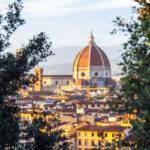

Piazza del Duomo represents the magnificent cultural and architectural heart of Florence, a UNESCO World Heritage masterpiece that embodies the genius of Renaissance Italy. This expansive square showcases an exceptional concentration of artistic achievement, centered around the breathtaking Florence Cathedral (Santa Maria del Fiore) with Brunelleschi’s innovative red-tiled dome dominating the skyline as a triumph of engineering and aesthetic harmony. The adjacent structures create a stunning ensemble: Giotto’s elegant Campanile rises with multicolored marble panels, while the ancient Baptistery of St. John features the renowned gilded “Gates of Paradise” bronze doors by Ghiberti that helped define Renaissance sculptural style. Visitors experience a living outdoor museum where medieval and Renaissance elements blend seamlessly with contemporary city life, as locals and travelers alike gather amid architectural marvels that have inspired artists for centuries. Beyond its visual splendor, the piazza serves as Florence’s spiritual center where religious traditions continue uninterrupted since medieval times, offering an authentic immersion into Florentine cultural identity where history feels palpably present amid the bustle of modern Italian life.
Cultural Context
Piazza del Duomo stands as a pivotal cultural landmark in Florence, deeply embedded in the artistic and spiritual traditions of the city. It serves as the epicenter for numerous religious ceremonies, including the annual Feast of Saint John the Baptist, Florence’s patron saint, celebrated with processions and fireworks that draw locals and visitors alike. The piazza is also a vibrant space for cultural gatherings, reflecting Florence’s enduring legacy as the cradle of the Renaissance. Local artisans and craftsmen often display their work around the square, continuing centuries-old traditions of marble carving, fresco painting, and goldsmithing. The piazza embodies the Florentine identity, where the convergence of religious devotion and civic pride manifests in public rituals, festivals, and daily life. Its open space encourages communal interaction, fostering a sense of shared heritage and continuity. The piazza’s role extends beyond tourism; it remains a living cultural hub where the past and present coexist, highlighting Florence’s commitment to preserving its rich artistic and spiritual lineage. This cultural vibrancy ensures that Piazza del Duomo is not only a site of historical importance but also a dynamic venue for ongoing cultural expression and community engagement.
Historical Context
Piazza del Duomo has been the historical heart of Florence since the Middle Ages, evolving through centuries as a symbol of the city’s political, religious, and artistic power. The site originally hosted a Romanesque cathedral, which was replaced in the late 13th century by the construction of the current Florence Cathedral, or Santa Maria del Fiore, designed initially by Arnolfo di Cambio. The piazza witnessed key historical moments, including the rise of the Medici family, whose patronage propelled Florence to Renaissance prominence. Throughout the 14th and 15th centuries, the area became a focal point for civic life, hosting public gatherings, religious events, and political proclamations. The completion of Brunelleschi’s dome in 1436 marked a turning point, showcasing Florence’s innovative spirit during a period of intense artistic and intellectual flourishing. Over the centuries, the piazza also endured social upheavals, including the brief establishment of the Florentine Republic and later integration into the Grand Duchy of Tuscany. In modern times, the piazza has been meticulously preserved and restored, maintaining its historical integrity while adapting to contemporary urban life. The layered history of Piazza del Duomo reflects Florence’s journey from medieval commune to Renaissance powerhouse and modern cultural capital.