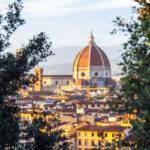
The Cathedral of Santa Maria del Fiore, commonly known as Florence Cathedral or the Duomo, is one of the world’s largest churches and the iconic centerpiece of Florence, Italy. Construction began in 1296 under Arnolfo di Cambio and was completed in 1436 with the addition of Filippo Brunelleschi’s revolutionary self-supporting dome—the largest masonry dome ever built. The cathedral’s exterior features a striking facade of white, red, and green marble with geometric patterns, while the interior houses magnificent artwork including Paolo Uccello’s clock, Domenico di Michelino’s “Dante Before the City of Florence,” and Vasari and Zuccari’s “Last Judgment” frescoes in the dome. As a masterpiece of Renaissance engineering and architectural innovation, the cathedral exemplifies Florence’s artistic and cultural significance during the Renaissance period.
Cultural Context
Renaissance masterpiece embodying Florence’s cultural supremacy and artistic innovation, symbol of humanist achievement blending engineering brilliance with spiritual devotion, birthplace of Renaissance architectural revolution
Historical Context
Begun 1296 by Arnolfo di Cambio replacing Santa Reparata, construction halted until Brunelleschi’s revolutionary dome 1420-1436, first octagonal dome built without scaffolding inspiring centuries of architectural innovation