A place worth knowing

Giotto’s Campanile

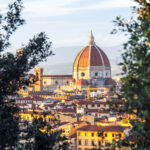
A 414-step climb up this 85-metre Gothic bell tower designed by Giotto in 1334 rewards with the closest views of Brunelleschi’s Dome and a panorama across Florence’s terracotta rooftops.

Historical landmarks · Bell tower in FlorenceUpdated

  • Google rating4.7/5 (55,000 reviews)
  • Typical visit30-60 minutes
  • EntranceAdmission required — check https://duomo.firenze.it/ for tickets
Giotto's Campanile Architecture
Cacio Murilo / Shutterstock.com
  • Today (Wednesday)Open 24 hours
  • Typical visit30-60 minutes
  • EntranceAdmission required — check https://duomo.firenze.it/ for tickets
  • Google rating4.7/5 55,000 reviews
  • WebsiteOfficial site ↗
Opening hours all week
Monday
Open 24 hours
Tuesday
Open 24 hours
Wednesday
Open 24 hours
Thursday
Open 24 hours
Friday
Open 24 hours
Saturday
Open 24 hours
Sunday
Open 24 hours
Accessibility
"{"rest": "Three platforms provide rest opportunities during climb", "width": "Wider stairs than Dome climb but still narrow passages", "health": "Not recommended for heart conditions, vertigo, or claustrophobia", "stairs": "414 steps with no elevator – not wheelchair accessible", "assistance": "Free entry for disabled with certification – email [email protected]", "alternative": "Opera del Duomo Museum offers accessible Dome model views"}"
The short answer

Why it matters

A 414-step climb up this 85-metre Gothic bell tower designed by Giotto in 1334 rewards with the closest views of Brunelleschi's Dome and a panorama across Florence's terracotta rooftops.

Rising elegantly beside Florence Cathedral, Giotto’s Campanile exemplifies the aesthetic revolution of the early Renaissance through its harmonious proportions and pioneering decorative program. Designed in 1334 by Giotto di Bondone—whose painterly innovations helped birth Renaissance art—the 84.7-meter bell tower represents a radical departure from medieval Gothic verticality toward classical balance and mathematical precision. Construction continued after Giotto’s death under Andrea Pisano and Francesco Talenti, who maintained fidelity to the original vision while adding their own refinements. The tower’s distinctive polychrome marble façade—white Carrara, green Prato, and pink Maremma—creates a geometric pattern echoing the adjacent Duomo and Baptistery, together forming Florence’s sacred architectural trinity. What distinguishes the campanile are the 56 relief panels designed by Giotto and executed by master sculptors including Andrea Pisano and Luca della Robbia. These panels—depicting human knowledge, crafts, virtues, planets, and sacraments—represent a comprehensive visual encyclopedia of medieval thought, transforming the tower into a three-dimensional textbook of 14th-century intellectual life. The 414-step climb rewards visitors with unparalleled views of Brunelleschi’s dome and the terracotta-tiled cityscape that cradled the Renaissance, offering a perspective on Florence that its original designers could only imagine.

Cultural Context

Masterpiece of Florentine Gothic architecture representing pinnacle of medieval Italian artistic achievement and religious devotion. Symbol of Florence cultural supremacy during Renaissance, showcasing integration of sculpture, architecture, and religious symbolism. Embodies Florentine civic pride and artistic patronage tradition.

Historical Context

Begun 1334 by Giotto di Bondone as bell tower for Cathedral of Santa Maria del Fiore. After Giotto death in 1337, continued by Andrea Pisano until 1348, completed by Francesco Talenti in 1359. Built during period of Florentine political strife, economic hardship, and Black Death, representing civic resilience and faith.

Context

Story and significance

About

Giotto’s Campanile is the free-standing bell tower of Florence Cathedral in Piazza del Duomo, rising 84.7 metres in Florentine Gothic style. Designed by Giotto di Bondone in 1334 and completed by Andrea Pisano and Francesco Talenti in 1359, the tower is clad in polychrome marble from Carrara (white), Prato (green), and Maremma (red) arranged in geometric patterns matching the cathedral. Its five levels feature 54 sculpted relief panels, 16 prophetic statues in niches, and windows that increase in complexity from single lancets to quadruplets at the belfry. A 414-step spiral staircase leads to panoramic views across Florence.

Historical significance

Giotto’s Campanile holds a pivotal place in the history of Renaissance art and architecture, symbolizing the burgeoning humanist ideals of 14th-century Florence. Commissioned in 1334 by the Opera del Duomo, the governing body overseeing the cathedral’s construction, the tower was initially designed by the celebrated painter and architect Giotto di Bondone, who is credited with pioneering a new approach to architecture that emphasized harmony, proportion, and naturalistic detail. Although Giotto died in 1337, the campanile was completed by his successors Andrea Pisano and Francesco Talenti, who preserved and expanded upon his vision. The tower’s construction coincided with Florence’s rise as a wealthy and influential city-state, reflecting its citizens’ pride and devotion through monumental art. Historically, the campanile functioned not only as a bell tower but also as a civic symbol of Florentine identity and power during a period marked by political strife and artistic flourishing. Its sculptural program, portraying biblical scenes alongside allegories of human knowledge and labor, underscores the era’s intellectual curiosity and the integration of religious and secular themes. Over the centuries, Giotto’s Campanile has inspired countless artists and architects, influencing the development of Renaissance architecture across Italy and beyond. Today, it stands as a testament to Florence’s enduring legacy as the cradle of the Renaissance, embodying the city’s innovative spirit and cultural achievements that continue to resonate worldwide.

Historical context

Begun 1334 by Giotto di Bondone as bell tower for Cathedral of Santa Maria del Fiore. After Giotto death in 1337, continued by Andrea Pisano until 1348, completed by Francesco Talenti in 1359. Built during period of Florentine political strife, economic hardship, and Black Death, representing civic resilience and faith.

Cultural context

Masterpiece of Florentine Gothic architecture representing pinnacle of medieval Italian artistic achievement and religious devotion. Symbol of Florence cultural supremacy during Renaissance, showcasing integration of sculpture, architecture, and religious symbolism. Embodies Florentine civic pride and artistic patronage tradition.

Architecture

Outstanding example of Tuscan Gothic architecture with 84.7-meter height and polychrome marble facade matching cathedral red, white, and green inlay. Features rich sculptural decorations in hexagonal and diamond-shaped bas reliefs with life-size statues. Houses seven bells including Santa Reparata, largest dedicated to original church patron saint.

Local significance

Essential component of UNESCO World Heritage Piazza del Duomo complex alongside Florence Cathedral and Baptistery. Major tourist destination offering panoramic city views from top. Symbol of Florence enduring cultural legacy and continues as active bell tower serving cathedral liturgical functions while attracting millions of visitors annually.

Experience

Make the most of it

Local tips
  • Members get free entry and skip lines
  • Gift shops have unique souvenirs
  • Museum cafes often serve quality local food
  • Late night openings often have special events
  • Special exhibitions require separate tickets
  • Visit during weekdays for fewer crowds
  • Check for combo tickets with nearby attractions
Hidden gems nearby
  • Rooftop terraces often have great city views
  • Lesser-known wings have amazing collections
  • Free guided tours at specific times
  • Hidden courtyards perfect for photos
  • Secret passages between galleries
  • Staff recommendations for must-see pieces
  • Archive rooms sometimes open for special tours
Special features
  • Giotto's Campanile is renowned for its exquisite Gothic architecture and its vibrant polychrome marble façade, which incorporates white, green, and pink stones sourced from Carrara, Prato, and Maremma respectively. This 84.7-meter-tall bell tower stands adjacent to the Florence Cathedral and is celebrated for its intricate sculptural decorations, including hexagonal panels and lozenges that depict the history of mankind, the arts, and the liberal sciences. These reliefs were designed by Andrea Pisano and Luca della Robbia, among others, and provide a visual narrative that complements the spiritual significance of the cathedral complex. The campanile’s vertical design is segmented by elegant cornices and mullioned windows, culminating in a slender spire that offers panoramic views of Florence and the surrounding Tuscan landscape. Visitors can climb its 414 steps to reach the top, where the vantage point reveals the city's iconic red-tiled roofs and landmarks such as the Palazzo Vecchio and the Arno River. The tower’s harmonious proportions and detailed ornamentation exemplify the transition from medieval to Renaissance aesthetics, making it a masterpiece of architectural innovation. Its bell system, historically used to mark time and call the faithful to prayer, remains an integral part of Florence’s cultural heritage. Giotto's Campanile is not only a visual marvel but also a testament to the collaborative artistry of some of the era’s most distinguished sculptors and architects, embodying the spirit of Florence’s artistic renaissance in physical form.
Editorial scores

How we rate it

Authenticity9/10
Accessibility score9/10
Family-friendly score8/10
Off-the-beaten-path4/10

Editorial scores on a 10-point scale, judged against places of the same kind.

Updated Data: Editorial research · Google Places ratings · Verified coordinates