
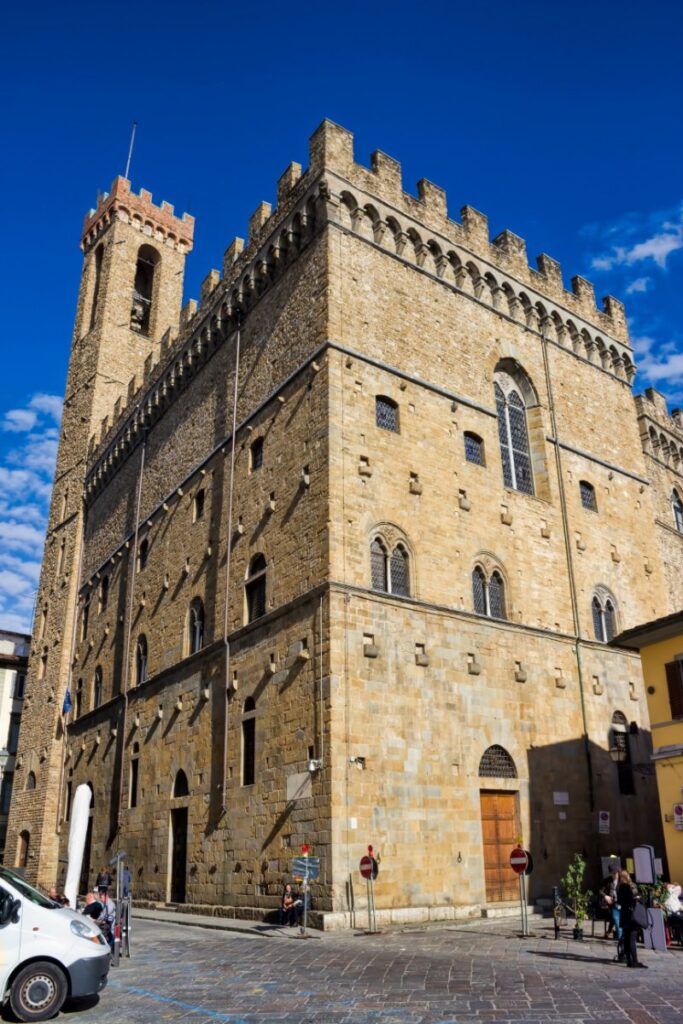
Housed in Florence‘s oldest public building—a 13th-century fortress that served as residence for the chief magistrate before becoming a prison and police headquarters—the Bargello Museum transformed this austere medieval structure into a sanctuary for Renaissance sculpture in 1865. The museum’s collection represents the evolution of Florentine plastic arts, with masterpieces by Donatello, including his revolutionary bronze David—the first freestanding nude since antiquity—and the ethereal marble St. George. Michelangelo’s early Bacchus and Brutus converse across rooms with Giambologna’s technically virtuosic Mercury and Cellini’s intimate models for Perseus. The building itself, with its imposing stone facade, crenellated tower, and open courtyard surrounded by gothic arches, provides a dramatically different architectural counterpoint to Florence’s Renaissance palaces. The first floor’s grand hall, once the setting for the city council, now showcases these sculptural treasures in what was originally a space of civic governance. Less crowded than the Uffizi but housing works of equal significance, the Bargello offers intimate encounters with three-dimensional masterpieces in atmospheric medieval spaces where visitors can appreciate how sculptural innovations—contrapposto poses, psychological expressiveness, technical virtuosity—paralleled Florence’s broader Renaissance achievements in art, humanism, and civic identity.
Cultural Context
Representing the heart of Italia’s food culture, this restaurant serves as a cultural bridge through its traditional regional cuisine and authentic preparation methods.
Historical Context
The Museo Nazionale del Bargello is housed in one of Florence’s most historically significant buildings, originally constructed in 1255 as the Palazzo del Podestà. This fortress-like structure served as the residence for the city’s chief magistrate, known as the Bargello, who was responsible for law enforcement and justice during the turbulent medieval period. Over time, the building’s function evolved: in the 16th century, it became a prison and the headquarters of the police chief, reflecting Florence’s political and social transformations. The Bargello remained a prison until the 19th century, when it was converted into a museum in 1865, shortly after Florence became the capital of the newly unified Kingdom of Italy. The museum was established to house and preserve a wide array of Renaissance sculptures and decorative arts, emphasizing Florence’s pivotal role in art history. Its collections include masterpieces by renowned artists such as Donatello, Michelangelo, and Verrocchio, highlighting the city’s artistic legacy. The Museo Nazionale del Bargello thus embodies centuries of Florentine civic, judicial, and artistic history, making it a vital cultural institution that narrates the city’s complex past from medieval governance to Renaissance brilliance and modern preservation.