MenuClose

A place worth knowing

Piazza Della Signoria

Attractions · Square in FlorenceUpdated

  • Google rating4.7/5
  • Typical visit30-90 minutes (longer if exploring surrounding museums and cafes)
  • EntranceFree
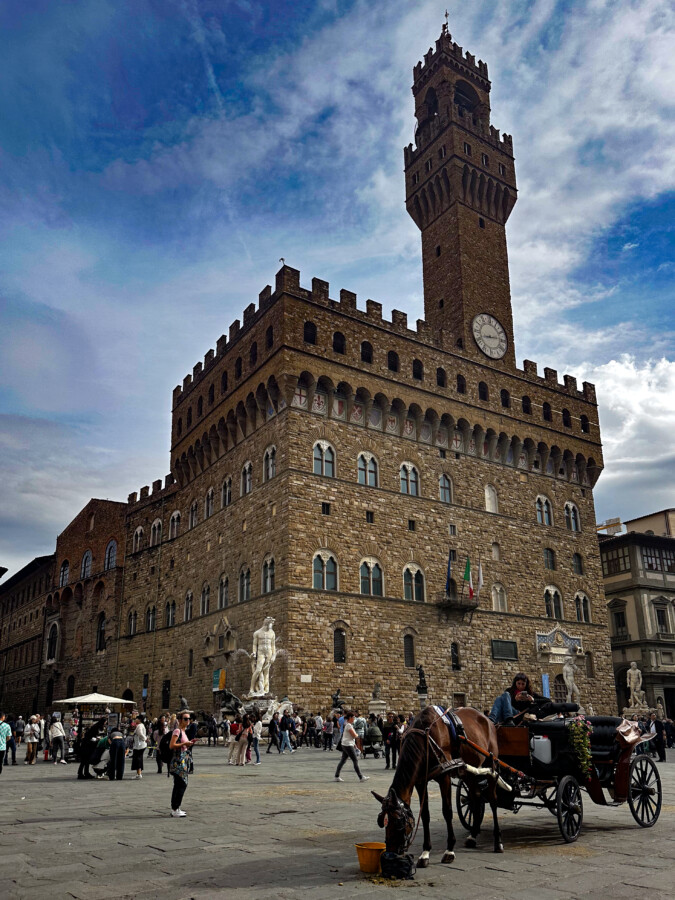
Horse Carriage at Piazza Della Signoria, Florence
Kyle Kroeger / ViaTravelers
  • Today (Tuesday)Open 24 hours
  • Typical visit30-90 minutes (longer if exploring surrounding museums and cafes)
  • EntranceFree
  • Google rating4.7/5
Opening hours all week
Monday
Open 24 hours
Tuesday
Open 24 hours
Wednesday
Open 24 hours
Thursday
Open 24 hours
Friday
Open 24 hours
Saturday
Open 24 hours
Sunday
Open 24 hours
Features
  • Cultural heritage
  • Incredible preservation
The short answer

Why it matters

Florence's political heart since the 14th century, an open-air sculpture gallery featuring a David replica, Neptune Fountain, and the Loggia dei Lanzi

The pulsing political heart of Florence since the 14th century, Piazza della Signoria serves as an open-air sculpture gallery where Renaissance power and artistry converge. Dominated by the fortress-like Palazzo Vecchio, this L-shaped square showcases masterpieces including a replica of Michelangelo’s David, Cellini’s Perseus, and the Neptune Fountain. Cafés spill onto the square where Florentines and visitors alike gather among centuries of history. Beyond its visual splendor, the piazza continues its centuries-old role as the city’s primary meeting place, offering an immersive window into both Florence’s illustrious past and vibrant present. Visit at different times to experience the square’s shifting moods—from the golden glow of morning light on ancient facades to the romantic illumination of evening.

Cultural Context

Piazza della Signoria stands as a vibrant cultural symbol deeply embedded in the social and artistic life of Florence. Since the Renaissance, it has functioned not only as a political center but also as a gathering place for Florentines during festivals, public ceremonies, and communal celebrations. The piazza has hosted traditional events such as the Festa della Rificolona, a lantern festival celebrated annually in Florence, where families and children parade with paper lanterns, illuminating the square with a warm glow. Additionally, the piazza remains an active venue for open-air performances, art exhibitions, and political demonstrations, reflecting its ongoing role as a space for public discourse and cultural expression. Local customs often involve leisurely gatherings at the numerous cafes and gelaterias lining the square, where residents and visitors alike engage in spirited conversations about art, politics, and daily life. The presence of iconic sculptures, including a replica of Michelangelo’s David, reinforces the community’s pride in its Renaissance heritage and artistic achievements. Piazza della Signoria thus continues to embody the living traditions of Florence, merging its historical legacy with contemporary cultural practices, making it an indispensable part of the city’s identity and communal life.

Historical Context

Piazza della Signoria has been the epicenter of Florentine political and social life since the 14th century, evolving through centuries as a symbol of civic power and artistic grandeur. Originally established around the Palazzo Vecchio, the seat of Florentine government, the piazza witnessed pivotal historical events such as the rise and fall of the Medici family, who ruled Florence for much of the Renaissance. In 1497, the square was the site of the public execution of the Dominican friar Girolamo Savonarola, a significant episode that underscored the intense religious and political conflicts of the era. Over time, the piazza transformed from a medieval marketplace into a grand Renaissance forum, shaped by influential figures including Cosimo I de’ Medici, who commissioned many of the sculptures and architectural enhancements. The square also served as a stage for public speeches, celebrations of military victories, and civic rituals that reinforced Florence’s identity as a republic and later as a ducal city. Through centuries of political upheaval, including the Napoleonic occupation and the unification of Italy, Piazza della Signoria remained a focal point for civic pride and historical memory. Its layered history reflects Florence’s evolution from a medieval commune to a Renaissance powerhouse and modern cultural capital.
Context

Story and significance

About

Piazza della Signoria, an open-air museum at Florence’s core, pulses with Renaissance grandeur. Behold the Palazzo Vecchio, its crenelated tower a sentinel of history, testifying to civic power and Medici influence. Here, masterpieces like Michelangelo’s David replica and Cellini’s Perseus stand time test offer a tangible connection to artistic genius.

Every cobblestone whispers tales of political intrigue and cultural flourish. It demands pause, urging travelers to linger where artists and statesmen once conferred. Allocate hours to absorb the piazza’s palpable majesty—a tribute to human creativity nestled in Florence’s timeless embrace. Come; let history animate your sojourn.

Historical significance

Piazza della Signoria is historically significant as the seat of Florentine government and as a public stage for events that shaped the city’s republican and later Medici-dominated history. Its sculptures and buildings embody Renaissance political power and artistic achievement that continue to inform Florence’s identity.

Historical context

The piazza developed in the medieval and Renaissance periods as the center of Florentine political life, bounded by governing buildings and serving as the site of proclamations, civic ceremonies and public gatherings. Over centuries it accumulated monumental architecture and sculpture that reflect Florence’s political and artistic prominence during the Renaissance.

Cultural context

Piazza della Signoria is Florence’s civic heart, an open square that functions as a social meeting place, outdoor sculpture gallery and a stage for public ceremonies. Locals and visitors gather there for the view of civic buildings, informal socializing and to encounter iconic statues and frequent street artists that express Florence’s public life.

Architecture

Architecturally the piazza is defined by the Palazzo Vecchio’s fortress-like Gothic-Renaissance facade, the Loggia dei Lanzi’s open-arched sculpture gallery and the ornate frontage of surrounding palaces, together creating a unified civic ensemble. The open space allows appreciation of outdoor sculpture and the interplay of medieval and Renaissance building forms in stone and marble.

Local significance

Piazza della Signoria functions as Florence’s political and social foyer, historically and today, where residents meet, protest, celebrate and pass through in daily life. The square’s civic buildings and outdoor sculptures make it a focal point for civic identity, linking contemporary Florentines to centuries of municipal government, artistic patronage and public discourse. For locals it is an accessible public space that supports cultural rituals, street life and the continuing presence of Florence’s historical narrative in everyday urban experience.

Editorial scores

How we rate it

Universal appeal & authenticity10/10
Cultural richness & educational value10/10
Preservation & integrity10/10
Accessibility & visitor engagement10/10

Editorial scores on a 10-point scale, judged against places of the same kind.

Updated Data: Editorial research · Google Places ratings · Verified coordinates