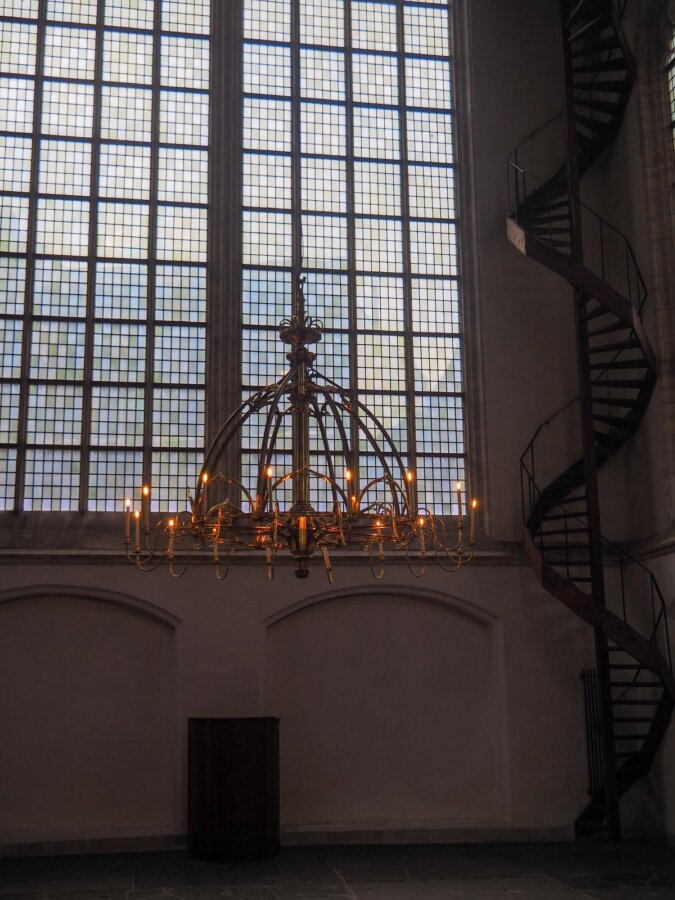
Standing as Amsterdam‘s oldest building, the Oude Kerk (Old Church) has witnessed the city’s entire history from its modest origins as a fishing village to global trading power. Founded around 1213 CE, this medieval sanctuary rises from the heart of the Red Light District, creating Amsterdam’s most striking juxtaposition of the sacred and profane. The soaring Gothic interior features a wooden barrel-vaulted ceiling—the largest medieval wooden vault in Europe—while sunlight filters through stained glass windows onto worn gravestones that pave the floor, marking the final resting place of Dutch luminaries including Rembrandt’s wife Saskia van Uylenburgh. Having survived the Protestant Reformation, when Catholic imagery was stripped from its walls, the church now hosts a paradoxical second life as a contemporary art space, where cutting-edge installations create dialogue with the ancient architecture. Visitors can climb the church tower for panoramic views across Amsterdam’s historic center, while the contrast between the reverent interior and the red-lit windows visible just beyond its walls encapsulates the Dutch pragmatic approach to balancing tradition with progressive values. As both Amsterdam’s oldest parish church and its most unexpected art venue, the Oude Kerk embodies the city’s layered identity and ongoing cultural evolution.
Cultural Context
The Oude Kerk holds a profound place in Amsterdam’s cultural fabric, serving as a focal point for both religious and secular traditions throughout its existence. Originally consecrated in 1306, the church has been a site for centuries of Christian worship, adapting through the Reformation to become a Protestant place of gathering. It embodies the evolving religious practices of Amsterdam’s diverse population, reflecting shifts from Catholicism to Calvinism and later embracing a more inclusive cultural role. The church also hosts contemporary art installations and concerts, blending historical reverence with modern cultural expression. Its location in De Wallen, Amsterdam’s historic Red Light District, situates it uniquely at the crossroads of sacred and profane, symbolizing the city’s complex relationship with morality, tolerance, and freedom. The Oude Kerk remains a venue for local celebrations and commemorations, including Remembrance Day ceremonies and special liturgical events, maintaining its role as a living cultural institution that connects Amsterdam’s past with its present social dynamics. This cultural significance extends beyond religious function, as the church is a testament to the city’s openness and resilience, continuously fostering community engagement through art, history, and spirituality. The Oude Kerk thus stands as a vibrant cultural landmark that encapsulates Amsterdam’s layered identity and ongoing dialogue between tradition and modernity.
Historical Context
The Oude Kerk is Amsterdam’s oldest building, with its foundation dating back to 1213 and consecration in 1306, marking it as a witness to over eight centuries of the city’s development. Originally constructed as a small wooden chapel for local fishermen, it evolved into a grand Gothic hall church as Amsterdam grew from a modest settlement into a major European trading hub. The church has survived multiple significant historical events, including the Reformation in the 16th century when it transitioned from Catholic to Protestant worship, reflecting the broader religious upheavals across the Netherlands. Notably, the church was a central site during the Dutch Golden Age, where prominent figures such as Rembrandt’s family were baptized or married. The Oude Kerk also endured damage during the Second World War but was carefully restored, preserving its historical integrity. Throughout its history, it has served as a burial site for notable Amsterdam citizens, including sea captains, artists, and local dignitaries, whose tombstones and epitaphs remain visible today. The church’s continuous adaptation to Amsterdam’s social and political changes illustrates its resilience and importance as a historical monument, making it an essential repository of the city’s collective memory and heritage. This layered history enriches the visitor experience, offering insights into the development of Amsterdam from medieval times to the present day.