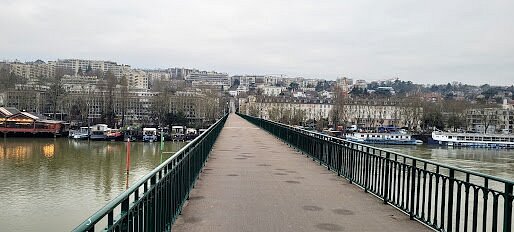
The Passerelle de l’Avre is a testament to 19th-century engineering and a significant piece of Paris‘ architectural heritage. Constructed under Gustave Eiffel’s guidance, this bridge-aqueduct spans the Seine, connecting Paris to Saint-Cloud and offering exceptional views of the Eiffel Tower.
Cultural Context
The Passerelle de l’Avre holds a subtle yet meaningful place within the cultural fabric of Paris, reflecting the city’s longstanding relationship with its waterways and urban connectivity. Situated in the 15th arrondissement, this pedestrian bridge serves not only as a practical crossing over the Avre aqueduct but also as a symbol of Parisian dedication to blending utility with aesthetic harmony. The bridge is often frequented by locals who appreciate its quiet charm amid a bustling metropolis, embodying the Parisian tradition of valuing small, intimate urban spaces that foster community interaction. While it does not host major festivals or celebrations, the Passerelle de l’Avre is part of the daily rhythm of the neighborhood, linking residents to green spaces and local markets, and offering a serene vantage point for observing the subtle interplay of natural and built environments. Its understated presence reflects broader French cultural values of preserving historical infrastructure while integrating it seamlessly into contemporary urban life. Visitors and Parisians alike experience the bridge as a modest yet meaningful testament to the city’s layered history and ongoing commitment to pedestrian-friendly urban planning. The Passerelle de l’Avre thus contributes quietly but significantly to the cultural identity of its locale, underscoring the Parisian ethos of living harmoniously with the city’s waterways and architectural heritage.
Historical Context
The Passerelle de l’Avre was constructed in the late 19th century, a period marked by rapid urban expansion and modernization in Paris under the direction of engineers and planners inspired by Baron Haussmann’s transformative vision. Completed around 1894, the bridge was built to span the Avre aqueduct, an essential water conduit supplying Paris with fresh water from the Avre River, located approximately 140 kilometers southwest of the city. This aqueduct itself was constructed between 1893 and 1899 to address the growing demand for potable water as Paris’ population surged during the Third Republic. The bridge’s creation was integral to maintaining pedestrian access across the aqueduct channel, connecting neighborhoods in the 15th arrondissement and facilitating daily movement. Historically, the Passerelle de l’Avre reflects the era’s engineering advancements and the city’s commitment to improving urban infrastructure while preserving public accessibility. Its existence is tied to the broader narrative of Parisian modernization, including the development of waterworks and transportation networks that supported the city’s transformation into a modern capital. Throughout the 20th century, the bridge has remained a functional and symbolic link, witnessing the evolution of its surroundings from industrial zones to vibrant residential districts. The Passerelle de l’Avre thus embodies a critical moment in Paris’ urban history, bridging the technological progress of the late 1800s with the lived experience of contemporary city life.