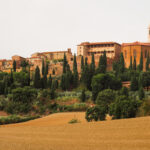
I spent several days in Tuscany and photographed San Gimignano at twilight, when the stone lanes and tower silhouettes are especially striking. My practical advice is to give the town at least four to six hours, prioritize the Duomo and Torre Grossa, then leave the two main piazzas long enough to see Sant’Agostino, the Rocca, or the medieval fountains.
The best things to do in San Gimignano are walking through Piazza della Cisterna and Piazza del Duomo, seeing the frescoes inside the Collegiata, climbing Torre Grossa, exploring the historic tower houses, and tasting Vernaccia di San Gimignano. A full day lets you add Casa Campatelli, Sant’Agostino, San Gimignano 1300, and the Fonti Medievali without rushing.
Planning details were last verified on July 23, 2026. Opening hours, ticket prices, bus schedules, and traffic rules can change, so check the linked official sources before your visit.
| Planning question | Practical answer |
|---|---|
| How long do you need? | Four to six hours for the main sights; one full day for museums, churches, viewpoints, and the fountains. |
| Top priorities | Piazza della Cisterna, the Collegiata, Palazzo Comunale, and Torre Grossa. |
| Best free sights | The two main piazzas, Rocca di Montestaffoli, Sant’Agostino, Porta delle Fonti, and Fonti Medievali. |
| Best combined ticket | The San Gimignano Pass currently costs €15 for adults, is valid for three days, and covers the Collegiata complex and Civic Museums. |
| Driving advice | Park outside the walls. The historic center has a camera-controlled limited-traffic zone. |
| Public transport | San Gimignano has no railway station. Travel by train to Poggibonsi, then continue by local bus. |
In this guide
- What San Gimignano is known for
- The 12 best things to do in San Gimignano
- A practical one-day itinerary
- How to get there and where to park
- Tickets, hours, and accessibility
- Frequently asked questions
What is San Gimignano known for?

San Gimignano is known for its medieval tower houses, frescoed churches, compact walled center, and local wine. The town was an important stop on the Via Francigena, the pilgrimage route linking northern Europe with Rome. Wealthy families built roughly 72 tower houses as symbols of status and security; UNESCO records that 14 survive.
The historic center entered the UNESCO World Heritage List in 1990. Its preservation is partly connected to a difficult history: plague struck in 1348, and the town came under Florentine control in 1353. San Gimignano then lost political and economic importance, which limited the large-scale redevelopment seen in many other Italian towns.
The skyline draws the attention first, but the art deserves equal time. The Collegiata contains major 14th- and 15th-century fresco cycles, while the Palazzo Comunale and Sant’Agostino hold works by artists including Lippo Memmi, Benozzo Gozzoli, Pinturicchio, and Filippino Lippi. This concentration of architecture and art explains why San Gimignano belongs on a broader itinerary of UNESCO World Heritage sites in Europe.
12 best things to do in San Gimignano
1. Enter through Porta San Giovanni and walk Via San Giovanni

Porta San Giovanni is the most natural starting point if you park south of the historic center. The gate opens onto Via San Giovanni, a long pedestrian street lined with stone buildings, food shops, ceramics, leather goods, and views toward the towers ahead.
Do not treat this stretch as a corridor to hurry through. Look for side alleys, worn doorways, brick arches, and glimpses of the countryside between buildings. The route rises gradually toward Piazza della Cisterna, so comfortable shoes make a noticeable difference on the cobbles.
My tip: walk the street once in daylight and again near sunset if you are staying late. Many of my photographs from San Gimignano were taken around twilight, when the warm street lighting separates the stone facades from the darkening sky.
2. Spend time in Piazza della Cisterna
Piazza della Cisterna is the triangular main square most travelers picture when they think of San Gimignano. Its name comes from the octagonal travertine well at the center. Medieval palaces and tower houses frame the sloping brick pavement, including Torre del Diavolo and buildings connected with the Ardinghelli, Becci, and Cugnanesi families.
The square works as a practical base because it connects Via San Giovanni, Via San Matteo, and Piazza del Duomo. It is also where you will find cafes, shops, and Gelateria Dondoli. Pause long enough to study the irregular rooflines instead of only taking a wide-angle photograph from the entrance.
Early morning gives you the clearest view of the paving and well. Evening is better for atmosphere, especially if you can stay after many day-trip groups have departed.
3. See Piazza del Duomo and the Collegiata

Piazza del Duomo sits directly beside Piazza della Cisterna but feels more enclosed and ceremonial. The Collegiata di Santa Maria Assunta, commonly called the Duomo, faces the Palazzo Comunale, Torre Grossa, Torre Rognosa, and the twin Salvucci towers.
The church is not technically a cathedral because San Gimignano is not an episcopal seat, but the familiar name “Duomo” remains useful for visitors. Its plain Romanesque exterior gives little warning of the painted interior. Fresco cycles cover much of the nave, including Old and New Testament scenes, Taddeo di Bartolo’s Last Judgment, and Domenico Ghirlandaio’s Chapel of Santa Fina.
Allow at least 30 to 45 minutes inside. The church has shorter Saturday hours and opens later on Sundays, so check the official Collegiata schedule before building your day around it. Religious services and special dates can also affect access.
4. Visit Palazzo Comunale, the Pinacoteca, and Torre Grossa
The Civic Museums combine three of San Gimignano’s strongest experiences: the historic town hall, a compact art gallery, and the highest public viewpoint in the center. Inside the Palazzo Comunale, the Sala di Dante contains Lippo Memmi’s large Maestà, while the Pinacoteca displays Sienese and Florentine works from the 13th through 15th centuries.
Torre Grossa rises about 54 meters above the town and is the main historic tower open for a conventional public climb. The ascent involves many steps, but the upper platform gives a clear view over tiled roofs, surviving tower houses, vineyards, and the Val d’Elsa countryside.
This is the paid attraction I would prioritize if time is limited. Reserve a timed tower entry during busy periods, then visit the gallery before or after the climb. The current San Gimignano Pass includes the Civic Museums and Collegiata complex.
Travelers interested in the collection can also use our guide to the best museums in Europe to place San Gimignano’s civic art in a wider itinerary.
5. Learn to identify the historic towers

San Gimignano becomes more interesting once the skyline stops looking like a row of anonymous stone shafts. In Piazza del Duomo, compare the broad Torre Rognosa with the slender twin Torre dei Salvucci. Torre Chigi is shorter and easier to miss, with a distinctive mix of stone and brickwork.

Torre dei Cugnanesi is near the Arco dei Becci and the route into Piazza della Cisterna, rather than standing in the center of the piazza itself. Its severe profile reflects the defensive character of the Cugnanesi family’s buildings. Most towers are viewed from the street, so the value lies in understanding how they shaped family compounds, movement, and status within the medieval town.
A self-guided tower walk costs nothing and adds context to every later viewpoint. Use the town’s tourist map to mark Torre Grossa, Rognosa, Salvucci, Chigi, Cugnanesi, Becci, Ardinghelli, and Torre del Diavolo.
6. Tour Torre e Casa Campatelli

Torre e Casa Campatelli shows how a medieval tower house evolved into a later family residence. The FAI property combines a 12th-century tower with furnished rooms, paintings, documents, and household objects associated with the Campatelli family.
The visit is useful because it brings the town’s architecture down to a domestic scale. Instead of seeing towers only as skyline monuments, you can understand how rooms, circulation, furniture, and family history accumulated around them. The standard self-guided route takes about 45 minutes.
Check the official FAI calendar before visiting because opening days and winter hours vary. The building has three floors connected by stairs, which can be difficult for visitors with reduced mobility.
7. Walk up to Rocca di Montestaffoli

Rocca di Montestaffoli occupies the remains of a Florentine fortress built after San Gimignano submitted to Florence in 1353. The surviving walls now enclose a public green space above the western side of town.
The Rocca is a useful alternative if you want a broad countryside view without buying another museum ticket. Walk the walls, look back toward the towers, and note how sharply the town drops into vineyards and fields. The space also hosts seasonal events, so access can change during concerts or festivals.
The Vernaccia di San Gimignano Wine Experience operates within the Rocca complex. It can be a convenient introduction to the denomination if you do not have time for a winery outside town, though tasting availability and hours should be confirmed in advance.
8. See the frescoes in Sant’Agostino
Sant’Agostino is the most important omission in many rushed San Gimignano itineraries. The late-13th-century church stands near Porta San Matteo, about a ten-minute walk north of Piazza del Duomo. Its restrained exterior opens into a space filled with medieval and Renaissance art.
The main reason to visit is Benozzo Gozzoli’s fresco cycle on the life of Saint Augustine, painted in 1464 and 1465. The church also contains works associated with artists including Piero del Pollaiolo, Bartolo di Fredi, and Benedetto da Maiano.
Admission is generally free, making this one of the best-value cultural stops in town. Dress respectfully, keep voices low, and avoid interrupting services. Seasonal opening hours often include a midday closure; confirm them through the official tourist information office.
9. Walk through Porta delle Fonti to the Fonti Medievali

Porta delle Fonti leads away from the busiest streets and down a steep path beneath the eastern walls. The gate is modest compared with Porta San Giovanni, but its position reveals how residents reached the town’s water supply.

The Fonti Medievali consist of a long series of stone arches sheltering basins fed by natural springs. Different sections date from the medieval period, and the site makes San Gimignano’s water system tangible in a way the central cistern cannot.
This detour takes effort because the return is uphill. Allow 30 to 45 minutes from the center, carry water in hot weather, and wear shoes with grip. It is a strong choice for travelers who want architecture and daily-life history without another ticketed attraction.
10. Study the city model at San Gimignano 1300

San Gimignano 1300 centers on a 27-square-meter ceramic reconstruction of the town as it may have appeared in the 14th century. The model contains roughly 800 buildings, including the full group of 72 tower houses, and took a team of architects, historians, and artisans three years to create.
I have a soft spot for detailed city models, and this one helps solve a real visitor problem: the surviving towers make more sense when you can see the dense medieval town around them. Displays also cover the Via Francigena, urban trades, farming, and the lost Convent of San Francesco.
The museum is compact and works well for families or bad weather. Current hours were not clearly published on the pages available during this update, so verify directly with San Gimignano 1300 before relying on it as a fixed itinerary stop.
11. Try gelato at Gelateria Dondoli

Gelateria Dondoli has operated in Piazza della Cisterna since 1992 and is one of San Gimignano’s best-known food stops. Its reputation is tied to master gelato maker Sergio Dondoli, international recognition, and a long-running three-cone rating in the Gambero Rosso guide.
Older travel articles often say the shop was named “best gelato in the world” twice. That wording is too loose. Dondoli’s official record lists several honors, including a 2024 recognition for the “world’s most famous gelato,” while Sergio Dondoli has held senior roles in the Gelato World Cup. The defensible reason to visit is the shop’s documented craft reputation, not an inflated title.

Check the flavor board rather than defaulting to a familiar choice; the selection changes and includes house specialties. Lines are usually easiest to manage outside the lunch and mid-afternoon rush. If the queue is long, continue sightseeing and return later.
12. Taste Vernaccia and shop for San Gimignano saffron

Vernaccia di San Gimignano is the town’s defining wine. It became the first Italian wine awarded DOC status in 1966 and received DOCG status in 1993. The production zone is confined to the municipality of San Gimignano, and the wine must be based on the local Vernaccia grape under the denomination’s rules.
Expect a dry white wine with enough acidity for local pecorino, seafood, white meats, and saffron dishes. Styles range from young, fresh bottlings to more structured Riserva wines. The Wine Experience at the Rocca offers a town-center introduction, while vineyard visits outside the walls usually require a reservation. Our guide to the best wine regions in Italy provides more context for planning a wine-focused route.
Zafferano di San Gimignano DOP is the other protected local product to look for. Buy sealed threads with clear producer and origin information rather than anonymous powder. Saffron is potent, light-sensitive, and easy to adulterate, so packaging and provenance matter more than a bargain price.
A practical one-day San Gimignano itinerary
This route minimizes backtracking and leaves the steep Fonti Medievali detour until late afternoon. Adjust it for Sunday, when the Collegiata opens later.
| Time | Stop | What to do |
|---|---|---|
| 9:00 a.m. | Porta San Giovanni | Walk Via San Giovanni before the center becomes busier. |
| 9:30 a.m. | Piazza della Cisterna | See the well, towers, and medieval palaces in clear morning light. |
| 10:00 a.m. | Collegiata | Allow 30 to 45 minutes for the fresco cycles. On Sunday, move this stop to the afternoon. |
| 11:00 a.m. | Palazzo Comunale and Torre Grossa | Visit the Pinacoteca and use a reserved tower time if available. |
| 12:30 p.m. | Piazza della Cisterna | Lunch nearby, followed by gelato at Dondoli if the line is reasonable. |
| 2:00 p.m. | Torre e Casa Campatelli | See the furnished tower-house museum; confirm its seasonal schedule. |
| 3:00 p.m. | Rocca di Montestaffoli | Walk the walls and consider a Vernaccia tasting. |
| 4:00 p.m. | Sant’Agostino | See Benozzo Gozzoli’s fresco cycle, subject to church hours. |
| 5:00 p.m. | Porta delle Fonti and Fonti Medievali | Make the downhill-and-uphill detour if energy and weather allow. |
| 6:00 p.m. | Historic center | Shop for Vernaccia or saffron, then revisit the piazzas in softer light. |
If you have only half a day, keep Piazza della Cisterna, the Collegiata, Palazzo Comunale, and Torre Grossa. Add either the Rocca or Sant’Agostino, not both. Travelers comparing guided options can review these food, walking, and bike tours in Italy, but confirm that any itinerary includes enough independent time inside the historic center.
How to get to San Gimignano
Driving, parking, and the ZTL
Driving is the simplest option for a flexible Tuscany itinerary, but private visitors should not enter the historic center unless their vehicle is authorized. San Gimignano’s camera-controlled ZTL became fully operational on May 1, 2026. Follow parking signs rather than a navigation app that tries to route you through a gate.
- P1 Giubileo: the cheaper large lot south of town. The current first-day maximum is €7, followed by a walk or local bus uphill.
- P2 Montemaggio: the most convenient southern lot for Porta San Giovanni. The current first-day maximum is €15.
- P3 Bagnaia Superiore and P4 Bagnaia Inferiore: useful when approaching from the north, with current first-day maximums of €15.
Rates above were verified against the Comune di San Gimignano parking page in July 2026. Travelers staying inside the walls should ask their accommodation about luggage drop-off and vehicle authorization before arrival. Do not assume a hotel booking automatically registers your license plate.
For broader budgeting, include tolls, fuel, parking, and possible rental-car insurance when estimating how much a trip to Italy costs.
Getting there by public transport
San Gimignano has no railway station. The standard rail-and-bus route is a train to Poggibonsi-San Gimignano station, followed by an Autolinee Toscane bus to Porta San Giovanni or Piazzale Montemaggio. Lines 130 and 133 serve relevant connections.
From Florence, take the train to Poggibonsi and transfer to the bus. From Siena, some line 130 services continue toward San Gimignano, while others require attention to the timetable or a connection. Check the live schedule on the day of travel, allow transfer time, and validate or activate the bus ticket as required.
Tickets, opening hours, and accessibility
Is the San Gimignano Pass worth it?
At the price verified in July 2026, the San Gimignano Pass costs €15 for adults and €12 for visitors ages 6 to 17, plus a €1 reservation fee when applicable. It is valid for three days and includes the Collegiata complex, Palazzo Comunale, Pinacoteca, Torre Grossa, the Santa Chiara complex, and San Lorenzo in Ponte.
The pass is good value if you plan to visit both the Collegiata and Civic Museums. A visitor interested only in the church or only in the tower complex may spend less with an individual ticket. Compare current prices on the official museum site before purchasing.
Plan around seasonal and religious hours
The Civic Museums currently use longer hours from April through October and shorter hours from November through March. The Collegiata also changes seasonally, closes earlier on Saturday, and usually opens at 12:30 p.m. on Sunday. Sant’Agostino may close at midday. These differences matter more than the town’s compact size suggests.
Check official pages one or two days before visiting, especially around Christmas, Easter, religious celebrations, and local events. Book Torre Grossa and Casa Campatelli when timed reservations are offered.
Accessibility and mobility considerations
San Gimignano’s center has uneven cobbles, slopes, narrow lanes, and many historic buildings without step-free circulation. Torre Grossa requires a substantial stair climb. Casa Campatelli has three floors connected by stairs. The Fonti Medievali route is steep in both directions.
Travelers with limited mobility can still experience the principal piazzas, street-level architecture, and several churches, but the best route depends on current access conditions. Use designated accessible parking, review the individual museum access pages, and contact the tourist office before arrival for the most reliable route. A companion is admitted free at several municipal and FAI sites when the published eligibility rules are met.
Is it worth staying overnight in San Gimignano?
A day trip covers the principal attractions, but an overnight stay changes the pace. You can photograph the streets after dinner, return to Piazza della Cisterna in evening light, and start the next morning before working through museum schedules.
Staying overnight also makes sense if you plan a winery visit, want to walk part of the Via Francigena, or prefer to split the Collegiata and Civic Museums across two days. For a wider trip, use the San Gimignano destination guide and our Italy travel guide to connect the town with Siena, Florence, Volterra, or other beautiful towns in Europe.
For most first visits, the strongest plan is simple: start with the two central piazzas, choose one paid cultural complex, and reserve enough energy for a quieter stop beyond the central route. That balance shows why San Gimignano is more than a skyline photo.
Frequently asked questions about San Gimignano
Is San Gimignano worth visiting?
Yes. San Gimignano is worth visiting for its preserved medieval tower-house skyline, major fresco cycles, compact historic center, Vernaccia wine, and easy day-trip logistics. Four to six hours covers the main sights, while a full day allows time for museums and the medieval fountains.
How long do you need in San Gimignano?
Plan four to six hours for Piazza della Cisterna, the Collegiata, Palazzo Comunale, and Torre Grossa. A full day is better if you also want Casa Campatelli, Sant’Agostino, the Rocca, San Gimignano 1300, or the Fonti Medievali.
Can you visit San Gimignano as a day trip from Florence or Siena?
Yes. San Gimignano is a practical day trip from both cities. Driving is the most flexible option. By public transport, travelers from Florence usually take a train to Poggibonsi and continue by bus; services from Siena use the regional bus network.
Does San Gimignano have a train station?
No. The nearest useful rail station is Poggibonsi-San Gimignano. From there, continue by Autolinee Toscane bus to Porta San Giovanni or Piazzale Montemaggio.
Which tower can you climb in San Gimignano?
Torre Grossa is the principal historic tower open to the public through the Civic Museums. Timed reservations may be used during busy periods. The climb involves many stairs and is not step-free.
Is the San Gimignano Pass worth buying?
The pass is worthwhile when you plan to visit both the Collegiata complex and the Civic Museums with Torre Grossa. It was priced at €15 for adults and valid for three days when verified in July 2026. Check the official site for current rates.
Can visitors drive into San Gimignano’s historic center?
Most visitors should not drive inside the walls. The center is covered by a camera-controlled limited-traffic zone, and unauthorized entry can lead to a fine. Use P1, P2, P3, or P4 unless your accommodation has confirmed an authorization procedure.