Quick answer: Angkor Wat is a 12th-century temple complex just north of Siem Reap, Cambodia. Built under Khmer King Suryavarman II and originally dedicated to Vishnu, it later became a Buddhist sacred site and remains part of the UNESCO-listed Angkor Archaeological Park. Most travelers should give Angkor Wat at least half a day, though a three-day Angkor pass is the better choice if you want to see Angkor Thom, Bayon, Ta Prohm, Preah Khan, and quieter temples beyond the main circuit.
Angkor Wat is not just another temple stop. Guinness World Records recognizes it as the largest religious structure ever built, covering 162.6 hectares. Its scale, west-facing layout, moat, lotus-bud towers, bas-reliefs, and Mount Meru symbolism make it one of the clearest windows into Khmer architecture and religion.
Last fact-checked: June 15, 2026. Ticket prices, opening hours, pass validity, visa rules, and safety advisories can change. Use the official links in this guide before you travel.
Key Takeaways for Visiting Angkor Wat
- Best base: Stay in Siem Reap, about 4 miles from the Angkor archaeological area.
- Best first visit: Sunrise at Angkor Wat, then the bas-relief galleries, Bakan upper sanctuary if open, Bayon, and Ta Prohm.
- Best pass for most travelers: The three-day pass gives better value than rushing the whole park in one day.
- Best weather window: Late November through February is typically drier and more comfortable; March to May is hotter, and the wet season brings heavier rain and greener scenery.
- Dress code: Cover shoulders and knees, especially for Bakan and active worship areas.
- Responsible travel: Stay on marked paths, do not touch carvings, avoid climbing ruins, and follow the APSARA visitor code of conduct.
Table of Contents
- Angkor Wat quick facts
- Where Angkor Wat is located
- Angkor Wat history
- Tickets, opening hours, and pass options
- What to see at Angkor Wat
- A practical one-day route
- Best time to visit
- Dress code and etiquette
- Where to stay near Angkor Wat
- FAQ
Angkor Wat Quick Facts
| Question | Answer |
|---|---|
| Where is Angkor Wat? | In Angkor Archaeological Park, north of Siem Reap, Cambodia. |
| What does Angkor Wat mean? | Commonly translated as “Temple City” or “City of Temples.” |
| When was Angkor Wat built? | In the first half of the 12th century, during the reign of King Suryavarman II. |
| What was it built for? | It was originally a Hindu temple dedicated to Vishnu and later became a Buddhist sacred site. |
| Why is it famous? | It is the world’s largest religious structure by area and one of the major monuments of Khmer architecture. |
| How long do you need? | Two to three hours for the main temple, half a day for a slower visit, and three days for the wider Angkor park. |
| Can you visit without a guide? | Yes, but a licensed guide adds useful context for bas-reliefs, symbolism, and route planning. |
| Main ticket source | Angkor Enterprise, the official Angkor pass provider. |
Where Is Angkor Wat Located?
Angkor Wat is in northwestern Cambodia, inside Angkor Archaeological Park near Siem Reap. The park covers far more than the single Angkor Wat temple. UNESCO describes Angkor as a roughly 400-square-kilometer archaeological landscape with temples, reservoirs, canals, roads, and remains of several Khmer capitals.
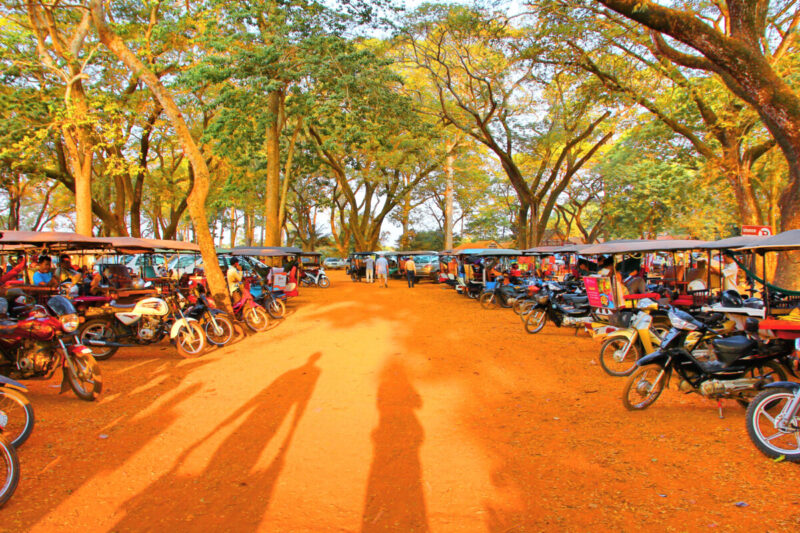
For travelers, the easiest base is Siem Reap. Most temple days start before sunrise with a tuk-tuk, private driver, bike, e-bike, or guided tour leaving from town. Angkor Wat is usually the first stop on the Small Circuit, which also includes Angkor Thom, Bayon, Ta Prohm, Banteay Kdei, and nearby temples.
What Is Angkor Wat?
Angkor Wat is the best-known temple within Angkor Archaeological Park, but it is not the whole Angkor complex. It was built as a state temple during the Khmer Empire and is widely interpreted as a symbolic model of Mount Meru, the sacred mountain at the center of Hindu cosmology.
The temple’s five central towers represent Mount Meru’s peaks. The galleries, walls, and moat create a layered movement from the outer world toward the sacred center. Unlike many Khmer temples, Angkor Wat faces west, a feature often connected to Vishnu and to funerary symbolism, though scholars still debate exactly how Suryavarman II intended every part of the design to function.
Angkor Wat later became a Buddhist place of worship. That religious continuity helped preserve it and explains why visitors today see Hindu epics, Buddhist imagery, monks, incense, offerings, and active sacred space in the same monument.
A Short History of Angkor Wat

Angkor Wat was built in the first half of the 12th century under King Suryavarman II. Its original dedication to Vishnu reflected the king’s religious and political vision: a temple that expressed divine order, imperial power, and cosmic geography through architecture.
Older travel writing often says Angkor Wat was “lost” and then “rediscovered.” That is too simple. The wider city of Angkor declined, and many structures suffered from vegetation, war, looting, and neglect, but Angkor Wat itself remained known locally and continued to hold religious meaning. Western explorers and scholars, including Portuguese visitor António da Madalena in the 16th century and French naturalist Henri Mouhot in the 19th century, helped popularize the site in Europe, but they did not discover a place unknown to Cambodians.
| Period | What happened | Why it matters |
|---|---|---|
| Early 12th century | Suryavarman II commissions Angkor Wat. | The temple becomes one of the defining works of Khmer architecture. |
| Late 12th century | Jayavarman VII later builds Angkor Thom and Bayon north of Angkor Wat. | The political and religious center of Angkor shifts, with Buddhism playing a larger role. |
| Late Angkor period | Angkor Wat gradually takes on Buddhist use and meaning. | The site’s religious continuity helps explain its preservation. |
| 15th–16th centuries | The old capital declines, but Angkor Wat remains a known sacred site. | This corrects the common “lost city” myth. |
| 19th–20th centuries | French scholarship and conservation work bring global attention. | Tourism and restoration reshape Angkor’s modern identity. |
| 1992 | Angkor is inscribed as a UNESCO World Heritage Site. | International conservation becomes central to the park’s management. |
| Today | APSARA, Cambodian authorities, and international teams manage conservation and visitor flow. | Visitors need to balance access with preservation. |
Architecture and Symbolism

Angkor Wat combines two major Khmer temple forms: the temple mountain and the gallery temple. The result is a monument that feels both vertical and processional. You move across the moat, pass through gates, walk along galleries, and climb toward the central sanctuary.
Look for these architectural details as you walk:
- Five lotus-bud towers: the central tower and four surrounding towers form a quincunx pattern associated with Mount Meru.
- Moat and outer wall: the water and enclosure reinforce the symbolic boundary between ordinary space and sacred space.
- Bas-relief galleries: long carved panels show Hindu epics, court scenes, heavens and hells, and the Churning of the Ocean of Milk.
- Devatas and apsaras: carved female figures appear throughout the temple and reward slow looking.
- West-facing orientation: unusual among Khmer temples and often tied to Vishnu and funerary interpretations.
The eastern gallery’s Churning of the Ocean of Milk is one of Angkor Wat’s most important carvings. The World Monuments Fund has worked on conservation of this gallery, where rainwater, salts, age, and visitor pressure can damage the carved surface.
Angkor Wat Tickets, Opening Hours, and Pass Options
Foreign visitors need an Angkor pass to visit Angkor Wat and the main temples in Angkor Archaeological Park. Buy tickets through Angkor Enterprise, the official ticket provider.
Important update: many older guides say the three-day pass is valid over 10 days. The official Angkor Enterprise online ticket page currently lists the three-day Angkor Temples Park pass as expiring in seven days and the seven-day pass as expiring in 30 days. Check the official page before publishing or traveling.
| Pass | Official price shown | Validity shown on official page | Best for |
|---|---|---|---|
| 1-day Angkor pass | $37 | Expires in 1 day | Travelers with limited time who only want Angkor Wat plus a few nearby highlights. |
| 3-day Angkor pass | $62 | Expires in 7 days | Most first-time visitors; enough time for Angkor Wat, Angkor Thom, Ta Prohm, Banteay Srei, and a slower day. |
| 7-day Angkor pass | $72 | Expires in 30 days | Photographers, archaeology travelers, repeat visitors, and slow travelers based in Siem Reap. |
The official ticket page lists Angkor Temples Park entry from 5:00 AM with closing at 6:30 PM. APSARA’s Angkor Wat page separately lists Angkor Wat from 5:00 AM to 5:30 PM and Bakan from 7:40 AM to 5:00 PM. In June 2026, APSARA also announced that Bakan would be open daily except for scheduled conservation closures from 1:00 PM onward on the 14th and 28th of each month. Because posted temple access can change for conservation, ceremonies, or safety, confirm the day’s hours with Angkor Enterprise, APSARA, your guide, or signage at the site.
What to See at Angkor Wat
Angkor Wat rewards a slow visit. Sunrise is famous, but the temple’s best details are in the galleries, towers, carvings, and changing light after the tour buses move on.
The Moat and Western Causeway
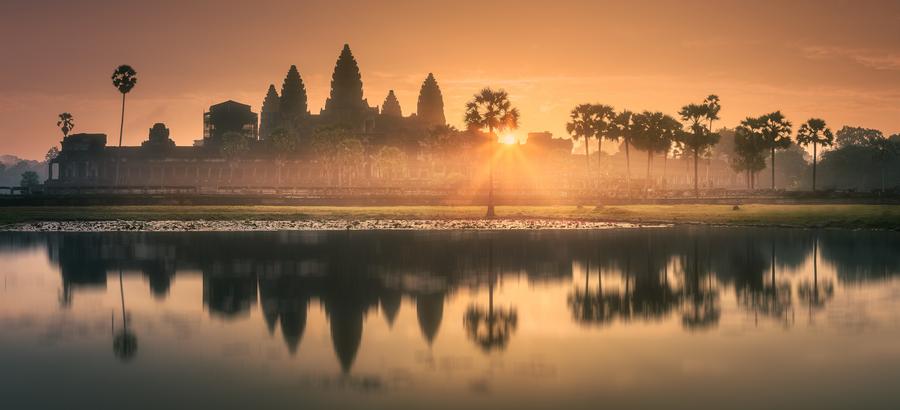
The approach across the western causeway gives you the classic view of the five towers. Arrive early for sunrise if that image matters to you, but return later if you want to study the entrance without shoulder-to-shoulder crowds.
The Bas-Relief Galleries
The outer gallery walls are among Angkor Wat’s most important features. Spend time with the Battle of Lanka, the Kurukshetra War, the procession of Suryavarman II, the heavens and hells panels, and the Churning of the Ocean of Milk. A guide is especially useful here because the carvings can look overwhelming without context.
Bakan, the Upper Sanctuary

Bakan is the upper level of Angkor Wat. The stairs are steep, access is managed, and dress rules are enforced. Children under 12 and pregnant visitors may be restricted for safety. If Bakan is a priority, do not assume sunrise access includes the upper level; it usually opens later than the main temple.
Ta Reach and Active Worship Areas
The Ta Reach statue near the western entrance remains an important devotional focus. This is where it helps to remember that Angkor Wat is not only an archaeological site. It is also sacred space. Keep your voice low, give worshippers room, and ask before photographing monks or people praying.
Nearby Temples Worth Adding
If you have one day, pair Angkor Wat with Bayon and Ta Prohm. If you have three days, add Preah Khan, Neak Pean, East Mebon, Pre Rup, and Banteay Srei. The wider park is the reason many travelers regret buying only a one-day pass.
Photo Gallery


A Practical One-Day Angkor Wat Route
One day is enough for the classic highlights, but not enough for the full Angkor park. Use this route if you have limited time and want a balanced first visit.
| Time | Stop | Why this works |
|---|---|---|
| 4:45–5:30 AM | Arrive for Angkor Wat sunrise | You get the classic silhouette and reflection before the heat builds. |
| 6:00–8:30 AM | Explore Angkor Wat’s galleries and central areas | The light is softer, and the bas-reliefs are easier to study before midday. |
| 7:40 AM onward, if open | Bakan upper sanctuary | Go early enough to avoid the longest queues and check scheduled access rules. |
| 9:30–11:00 AM | Bayon in Angkor Thom | The face towers are essential for understanding Jayavarman VII’s Angkor. |
| 11:30 AM–2:00 PM | Lunch and rest in Siem Reap or near the park | Midday heat can be punishing; a break keeps the day enjoyable. |
| 2:30–4:00 PM | Ta Prohm | Tree roots and collapsed galleries show a different side of Angkor conservation. |
| 4:30–sunset | Pre Rup or Phnom Bakheng | End with warm light, but arrive early if choosing crowded Phnom Bakheng. |
Some links in this article are affiliate links. ViaTravelers may earn a commission if you book through them, at no extra cost to you. Use tours as a tool, not a shortcut around learning the place.
If you want more context for the carvings and history, a guided sunrise tour can be worth it. If you prefer control over pace and photography stops, hire a private driver and a licensed guide separately. This guide to choosing between a tour operator or travel agent can help if Angkor is part of a longer Cambodia or Southeast Asia trip.
Best Time to Visit Angkor Wat
The best time to visit Angkor Wat for cooler, drier weather is usually late November through February. December and January tend to be among the driest months in Siem Reap, but they also bring more visitors and higher hotel demand.
March to May is hotter. If you visit then, start early, carry water, wear sun protection, and build in a midday break. The rainy season, roughly late April or May through October, can bring heavy showers and humidity, but it also means greener landscapes, dramatic skies, and fewer crowds outside peak holiday periods.
Best Time of Day
- Sunrise: best for the classic Angkor Wat silhouette, but expect crowds.
- Early morning: best balance of cooler weather and usable light.
- Midday: hot, but some tour groups leave for lunch; shaded galleries can be quieter.
- Late afternoon: good for warm light, but popular sunset points fill early.
Dress Code, Etiquette, and Safety
Angkor Wat is a sacred religious site and a fragile archaeological monument. Dress and behavior matter. For a deeper primer, read these tips for visiting ancient sites respectfully.
What to Wear
- Cover shoulders and knees.
- Wear breathable clothing that handles heat and humidity.
- Choose shoes with grip; sandstone steps can be steep and uneven.
- Bring a hat for the open areas, but remove it where posted rules require.
- Do not rely on a thin scarf as your only shoulder covering for upper-level access.
How to Behave at the Temples
- Do not climb on ruins or touch carvings.
- Do not sit on fragile ledges, statues, or temple thresholds.
- Keep your voice low around worshippers and monks.
- Ask before photographing monks or ceremonies.
- Carry out litter.
- Avoid giving money directly to children; support reputable local organizations instead.
Safety Notes
Stay on marked paths and use a knowledgeable local guide for remote temples or forested areas. The main Angkor temple complex and major towns have been cleared, but Cambodia still has landmines and unexploded ordnance in rural and border areas. Check current travel advisories before adding remote border temples to your itinerary.
Heat is the more common issue for most Angkor visitors. Carry water, use sun protection, take a midday break, and be realistic about cycling distances. Tuk-tuks are common around the park, but agree on the price and route before leaving.
How to Get Around Angkor Wat and Siem Reap
Most visits start in Siem Reap. Your best transport choice depends on your time, comfort level, budget, and heat tolerance.
| Option | Best for | Tradeoff |
|---|---|---|
| Tuk-tuk | Budget-friendly classic temple day | Open-air heat, dust, and rain exposure. |
| Private car and driver | Families, older travelers, hot-season visits | Costs more than a tuk-tuk. |
| Licensed guide | History, symbolism, bas-reliefs, efficient routing | Quality varies; book through reputable providers. |
| Bicycle or e-bike | Active travelers visiting at a slower pace | Heat, traffic, and distance can be harder than expected. |
| Small-group tour | Solo travelers and first-timers who want structure | Less flexibility for photography and rest breaks. |
Where to Stay Near Angkor Wat

Stay in Siem Reap rather than trying to sleep next to Angkor Wat. The town gives you better access to restaurants, markets, guides, drivers, and hotels across all budgets. Before booking, compare current map location, recent reviews, cancellation rules, breakfast timing, and whether the hotel can arrange early transport for sunrise.
If you are unsure what room type fits your trip, start with this guide to types of hotel rooms.
| Hotel example | Good fit | Booking note |
|---|---|---|
| Le Tigre Hotel | Budget-conscious travelers who want a simple Siem Reap base. | Check current distance to your pickup point and recent guest reviews. |
| HARI Residence & Spa | Travelers who want a pool, spa-style amenities, and central access. | Confirm current facilities and breakfast hours before booking sunrise days. |
| Koulen Hotel | Travelers who prefer more space and an Old French Quarter location. | Compare room type, cancellation policy, and family amenities. |
| Primefold Hotel | Couples or solo travelers looking for a smaller boutique-style stay. | Check recent photos and whether the location suits your evening plans. |
| Blossoming Romduol Boutique | Budget travelers comparing dorms or private rooms. | Review recent cleanliness, noise, and transport comments carefully. |
Responsible Travel at Angkor Wat
Angkor is a living cultural landscape, not an empty ruin. People live in and around the park, monks worship at temples, and conservation teams work year-round to protect fragile stone, carvings, and water systems.
The most useful thing visitors can do is simple: slow down. Do not treat the temple as a backdrop only. Hire local guides when it makes sense, follow posted rules, stay on paths, avoid drone use unless properly permitted, and spend money with local businesses that treat staff and communities fairly.
Is Angkor Wat Worth Visiting?
Angkor Wat is worth visiting if you care about architecture, history, religion, archaeology, photography, or Southeast Asian culture. It is also worth visiting if you want one destination that explains a larger story: Khmer imperial power, Hindu cosmology, Buddhist continuity, colonial-era scholarship, modern conservation, and the pressure tourism puts on sacred heritage.
It is not worth rushing through only for a sunrise photo. The famous reflection is beautiful, but the real value is in the galleries, symbolism, craftsmanship, and wider Angkor landscape. Give it time.
Related Travel Guides
- Phraya Nakhon Cave
- Ha Long Bay in Vietnam
- Meteora Monastery
- Salar de Uyuni
- Friend vacation ideas
- Family spring break destinations
- Sabbatical destination ideas
FAQs
Where is Angkor Wat located?
Angkor Wat is in Angkor Archaeological Park, just north of Siem Reap in northwestern Cambodia. Siem Reap is the usual base for visiting the temple.
When was Angkor Wat built?
Angkor Wat was built in the first half of the 12th century during the reign of Khmer King Suryavarman II.
How much does it cost to visit Angkor Wat?
The official Angkor Enterprise ticket page currently lists the Angkor Temples Park pass at $37 for one day, $62 for three days, and $72 for seven days. Prices and validity can change, so check the official ticket page before visiting.
How long do you need at Angkor Wat?
You need about two to three hours for the main temple, half a day for a slower visit, and at least three days if you want to explore the wider Angkor Archaeological Park without rushing.
Can you visit Angkor Wat without a guide?
Yes. You can visit independently with a tuk-tuk, driver, bicycle, or e-bike. A licensed guide is still useful for understanding the bas-reliefs, Hindu and Buddhist symbolism, and the history behind the temple layout.
Is Angkor Wat Hindu or Buddhist?
Angkor Wat was originally built as a Hindu temple dedicated to Vishnu. It later became a Buddhist sacred site, and Buddhist worship remains part of its identity today.
What is the dress code for Angkor Wat?
Cover your shoulders and knees, especially if you want to enter Bakan or active worship areas. Wear breathable clothing and shoes with grip because steps and stone surfaces can be steep, uneven, and hot.
What is the best time to visit Angkor Wat?
Late November through February usually offers the most comfortable weather. Sunrise gives you the iconic view, but early morning after sunrise is often better for exploring the galleries.
Can you see Angkor Wat in one day?
Yes, but one day is best for the highlights only: Angkor Wat, Bayon, Ta Prohm, and one sunset point. Choose a three-day pass if you want a fuller, less exhausting visit.
Do you need a visa for Cambodia?
Most international visitors need a visa for Cambodia. Check the official Cambodia e-visa site or your government’s travel advisory before booking flights, because visa rules depend on nationality and can change.