MenuClose

A place worth knowing

Bongeunsa Temple

Churches · Temple in SeoulUpdated

  • Google rating4.4/5 (15,000 reviews)
  • Typical visit1.5 to 3 hours (longer if attending a temple stay program or a specific event like a ceremony)
  • EntranceFree (donations welcome)
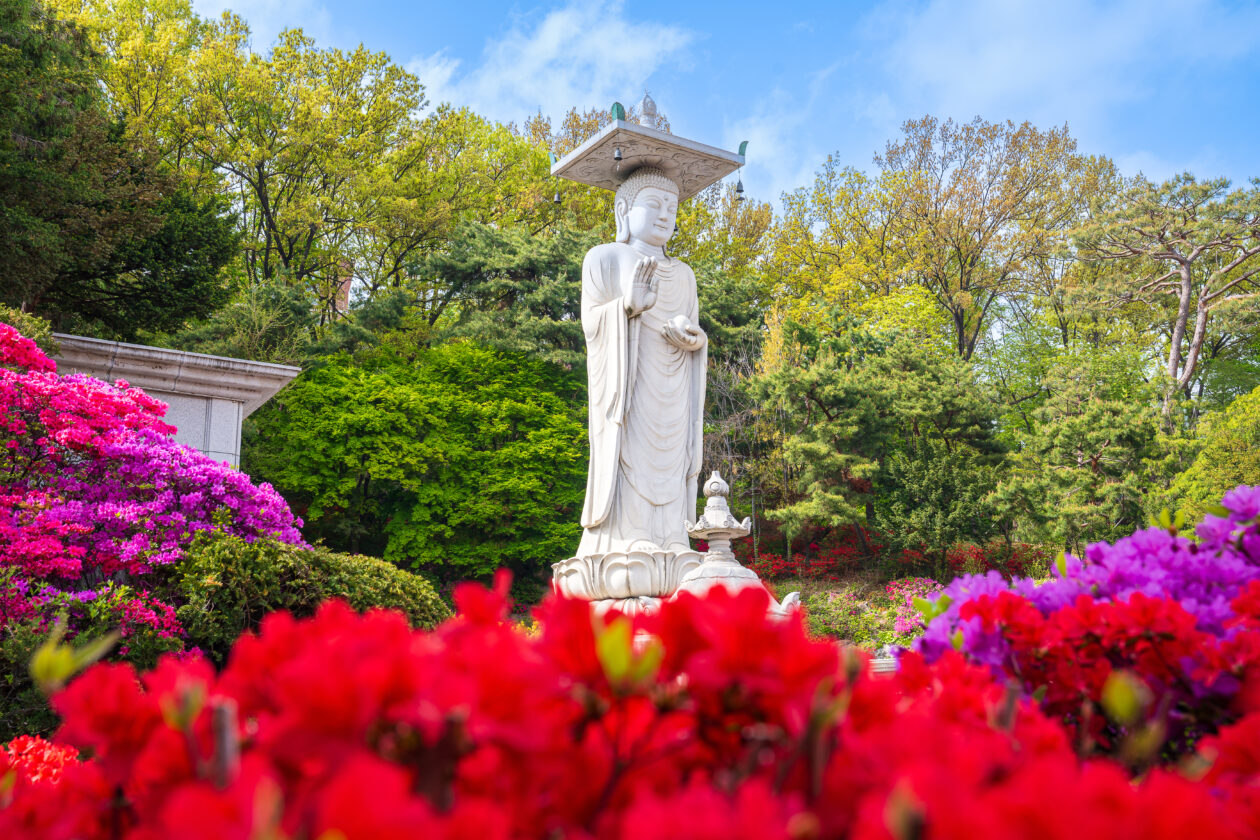
Bongeunsa Temple, Seoul, Buddha statue amid azalea blossoms in Gangnam garden.
  • Today (Monday)4:00 AM – 10:00 PM
  • Typical visit1.5 to 3 hours (longer if attending a temple stay program or a specific event like a ceremony)
  • EntranceFree (donations welcome)
  • Google rating4.4/5 15,000 reviews
  • WebsiteOfficial site ↗
Opening hours all week
Monday
4:00 AM – 10:00 PM
Tuesday
4:00 AM – 10:00 PM
Wednesday
4:00 AM – 10:00 PM
Thursday
4:00 AM – 10:00 PM
Friday
4:00 AM – 10:00 PM
Saturday
4:00 AM – 10:00 PM
Sunday
4:00 AM – 10:00 PM
Accessibility
"{"notes": ["Much more accessible than mountain temples", "Urban location in Gangnam provides full city accessibility"], "easyAccess": true, "facilities": ["Free admission makes it budget-accessible", "Daily 5 AM-9 PM hours accommodate all schedules", "English and Japanese language programs available"], "lastUpdated": "2025-08-01", "limitations": ["Historical architecture may limit access to some areas", "Hills and staircases in certain temple sections", "Buddha statue meditation platform requires shoe removal"], "accessibility": ["One of most accessible Buddhist temples in Korea", "Great for families with small children", "Bongeunsa Station Line 9 directly serves temple", "Short level walk from subway exit to temple entrance"], "publicTransport": true, "wheelchairAccess": "partial"}"
The short answer

Why it matters

A 1,200-year-old Buddhist temple tucked behind Gangnam's glass towers, home to a 23-metre Maitreya Buddha statue and a popular templestay programme.

Bongeunsa Temple is a significant Buddhist temple located in the heart of Seoul‘s modern Gangnam district, creating a striking contrast between traditional Korean architecture and the surrounding skyscrapers. Originally established in 794 CE during the reign of Silla King Wonseong by State Preceptor Yeonhoe, the temple was initially known as Gyeonseongsa. In 1498, Queen Jeonghyeon refurbished the temple and renamed it Bongeunsa. Despite its 1,200-year history, much of the temple’s original structures were destroyed during the Korean War and have since been meticulously restored to their former glory. The temple complex encompasses several notable buildings, including the Daeung-jeon Main Hall, which houses three gilded Buddha statues, and the Jijang-jeon Hall dedicated to Jijang Bosal, the Bodhisattva of the afterlife. One of Bongeunsa’s most remarkable features is its collection of woodblock carvings of the Avatamsaka Sutra (Flower Garland Sutra), a significant cultural treasure. The temple is also home to a towering 23-meter-high statue of Maitreya Buddha, overlooking the complex since its installation in 1986. As an active place of worship, Bongeunsa continues to serve as a spiritual center while offering visitors a peaceful retreat from the bustling city and a glimpse into Korea’s Buddhist heritage.

Cultural Context

Millennium-old Buddhist temple serving as a cornerstone of Korean Buddhism revival and the spiritual heart of modern Seoul’s Gangnam district. Founded in 794 CE, Bongeunsa represents the continuity of Korean Buddhist traditions through over 1,200 years of history, serving as a practicing temple for Seon (Zen) meditation and a center for spreading Korean Buddhism and culture worldwide through diverse programs including Templestay experiences.

Historical Context

Originally founded as Gyeonseongsa by State Preceptor Yeonhoe during King Wonseong’s reign in Silla Dynasty (794 CE), later becoming headquarters for 80 smaller Buddhist temples during Japanese occupation and achieving prominence as one of the Korean Empire’s 14 major temples in 1902. The temple survived Buddhist persecution during Joseon Dynasty and became central to Korean Buddhism’s modern revival under the Jogye Order, the largest Buddhist sect in Korea.


Context

Story and significance

About

Bongeunsa is a 1,200-year-old Buddhist temple founded in 794 AD during the Silla Dynasty, now situated in Gangnam directly across from the COEX Mall. From 1551 it served as the main centre of Seon (Zen) Buddhism in Korea for nearly 400 years. The temple houses 3,479 Buddhist scriptures including woodblock carvings of the Flower Garland Sutra, and a 28-metre stone Maitreya (Future Buddha) statue — among the tallest in the country. Twice daily, monks perform a four-instrument percussion ceremony. Templestay programs offer dawn services, Zen meditation, tea ceremonies, and traditional baru gongyang Buddhist meals.

Historical significance

Bongeunsa Temple holds profound historical significance as one of Korea’s oldest and most influential Buddhist temples, with origins tracing back to 794 AD during the Unified Silla period. Established by the monk Yeonhoe, the temple played a central role in the propagation and development of Korean Buddhism, particularly the Seon (Zen) tradition. Throughout the Joseon Dynasty, which often favored Confucianism over Buddhism, Bongeunsa remained a vital religious site, symbolizing resilience and continuity of Buddhist practice in Korea. The temple’s location in what is now the Gangnam district reflects the historical transformation of Seoul from its ancient roots to a modern metropolis, illustrating how religious institutions adapt to urban expansion. Bongeunsa also served as a place of refuge and spiritual guidance during periods of foreign invasions and political turmoil, including the Japanese invasions of the late 16th century and the Japanese occupation in the early 20th century. In contemporary history, Bongeunsa has contributed to the revival of Buddhism in South Korea, promoting interfaith dialogue and cultural preservation. The temple’s role in hosting international visitors and cultural events has helped foster greater understanding of Korean Buddhist traditions worldwide. Its legacy is not only religious but also cultural and social, reflecting the evolving relationship between spirituality and urban life in Korea. Bongeunsa’s enduring presence and continued relevance underscore its importance as a historical landmark that embodies the spiritual heritage and cultural identity of Seoul and the Korean people.

Historical context

Originally founded as Gyeonseongsa by State Preceptor Yeonhoe during King Wonseong’s reign in Silla Dynasty (794 CE), later becoming headquarters for 80 smaller Buddhist temples during Japanese occupation and achieving prominence as one of the Korean Empire’s 14 major temples in 1902. The temple survived Buddhist persecution during Joseon Dynasty and became central to Korean Buddhism’s modern revival under the Jogye Order, the largest Buddhist sect in Korea.
Cultural context

Millennium-old Buddhist temple serving as a cornerstone of Korean Buddhism revival and the spiritual heart of modern Seoul’s Gangnam district. Founded in 794 CE, Bongeunsa represents the continuity of Korean Buddhist traditions through over 1,200 years of history, serving as a practicing temple for Seon (Zen) meditation and a center for spreading Korean Buddhism and culture worldwide through diverse programs including Templestay experiences.

Architecture

Traditional Korean Buddhist temple architecture situated on the slope of Sudo Mountain, featuring classic temple design elements adapted to urban Seoul setting. The complex includes multiple halls and the notable Mireuk Daebul statue of the bodhisattva Maitreya, representing centuries of Korean Buddhist architectural traditions while maintaining functionality as an active monastery in the heart of a modern metropolis.

Local significance

Unique oasis of spiritual tranquility amid Seoul’s busiest commercial district, located directly across from COEX Mall in Gangnam, symbolizing the harmony between traditional Korean spirituality and modern urban life. The temple serves as a vital cultural bridge, attracting both local practitioners and international visitors seeking authentic Korean Buddhist experiences, while contributing to public welfare and maintaining Korean cultural identity in an increasingly globalized city.

Experience

Make the most of it

Local tips
  • Respectful behavior appreciated
  • Attend a service for full experience
  • Gift shops support maintenance
  • Early morning visits most peaceful
  • Guided tours explain symbolism
  • Lighting candles follows local customs
  • Local festivals bring special ceremonies
Hidden gems nearby
  • Hidden chapels with unique artwork
  • Ancient crypts open limited hours
  • Historical graves of notable figures
  • Original architectural elements preserved
  • Sacred relics in side chambers
  • Meditation gardens for quiet reflection
  • Acoustic properties for music
Special features
  • Bongeunsa Temple is distinguished by its harmonious blend of traditional Korean Buddhist architecture and its unique urban setting within the bustling Gangnam district of Seoul. Founded in 794 during the Silla Dynasty, the temple features several notable structures, including the Daeungjeon (Main Buddha Hall), which houses a large gilt-bronze statue of Buddha, emblematic of the Jogye Order of Korean Buddhism. One of the temple’s most distinctive elements is the enormous 23-meter tall statue of Maitreya Buddha, known as the Bongeunsa Maitreya, which symbolizes future hope and compassion. The temple grounds also include a serene lotus pond and meticulously maintained gardens that provide a tranquil retreat amid the city’s high-rise buildings. Bongeunsa is renowned for its cultural programs such as the Temple Stay experience, which offers visitors an immersive opportunity to learn about Buddhist meditation, chanting, and monastic life. The temple’s collection of Buddhist scriptures and artifacts reflects centuries of religious scholarship and artistic expression, contributing to its status as a living repository of Korean Buddhist heritage. Seasonal events like the Lotus Lantern Festival illuminate the temple with thousands of lanterns, creating a visually stunning celebration of Buddha’s birthday. The integration of modern cultural activities alongside traditional rituals makes Bongeunsa a vibrant center for both spiritual practice and cultural exchange, attracting locals and international visitors alike. This unique juxtaposition of ancient spiritual tradition within a contemporary urban environment defines Bongeunsa’s special character and enduring appeal to those seeking both cultural depth and peaceful reflection in Seoul.
Editorial scores

How we rate it

Authenticity8/10
Accessibility score7/10
Family-friendly score8/10
Off-the-beaten-path3/10

Editorial scores on a 10-point scale, judged against places of the same kind.

Updated Data: Editorial research · Google Places ratings · Verified coordinates