MenuClose

A place worth knowing

Piazza Navona

Attractions · Square in RomeUpdated

  • Google rating4.7/5
  • Typical visitSomething went wrong. Try again.
  • EntranceFree
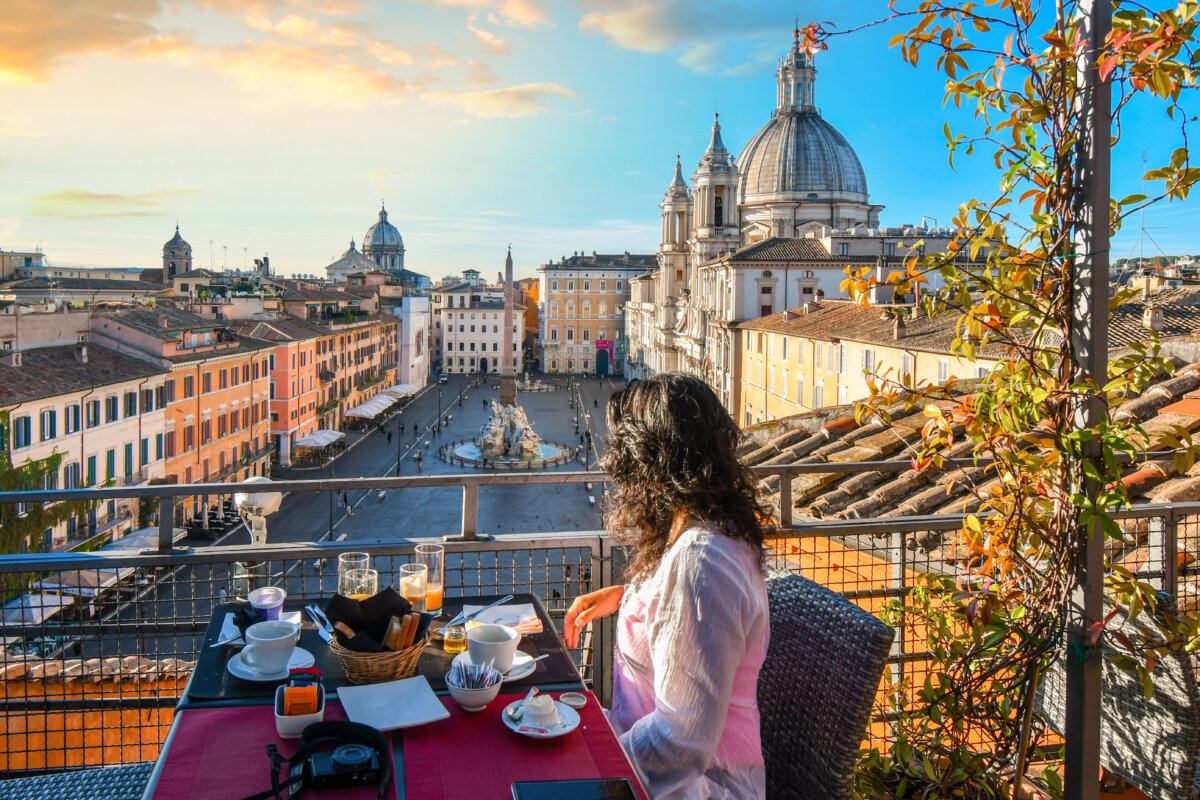
Woman enjoying a stunning view of Rome, Italy and the Piazza Navona from a rooftop terrace.
  • Today (Tuesday)Open 24 hours
  • Typical visitSomething went wrong. Try again.
  • EntranceFree
  • Google rating4.7/5
  • WebsiteOfficial site ↗
Opening hours all week
Monday
Open 24 hours
Tuesday
Open 24 hours
Wednesday
Open 24 hours
Thursday
Open 24 hours
Friday
Open 24 hours
Saturday
Open 24 hours
Sunday
Open 24 hours
Quiet times
Early morning (6:00-8:00), Weekday afternoons in winter, Late evening after 23:00, January and February (except holidays)
Busy times
10:00-13:00 daily, Weekends all day, Summer evenings (18:00-22:00), December (Christmas markets)
Accessibility
"{"crowds": "Can be very crowded, especially evenings", "nearby": "Accessible restaurants and facilities around plaza", "seating": "Limited public seating, cafe terraces available", "fountains": "Low barriers allow close viewing", "challenges": "Uneven ancient cobblestones can be difficult", "plaza_access": "Fully accessible, flat cobblestone surface"}"
The short answer

Why it matters

Rome's most elegant Baroque piazza built on the ruins of Domitian's stadium, with three grand fountains, cafes, and street performers

Piazza Navona embodies Rome‘s theatrical approach to urban design, where 2,000 years of history converge in one of the world’s most magnificent public spaces. Built over Emperor Domitian’s stadium from 86 CE, the piazza preserves the original oval racing track’s distinctive shape, with its historic foundations still visible beneath the current street level. The square’s baroque transformation reached its zenith under Pope Innocent X, whose family palace (now the Brazilian Embassy) overlooks three spectacular fountains created by the era’s greatest artists. At the center, Bernini’s Fountain of the Four Rivers (1651) presents a masterpiece of dramatic sculpture, with four colossal figures representing the Nile, Danube, Ganges, and Plate rivers surrounding an authentic Egyptian obelisk. The piazza functions as Rome’s vibrant living room, where locals and visitors alike enjoy the continual pageant of street performers, artists, and musicians against a backdrop of pastel-colored buildings and outdoor cafés. Throughout its history, the square has hosted mock naval battles during Renaissance festivals, served as Rome’s principal marketplace for nearly 300 years, and continues to transform seasonally—from summer evening promenades to the enchanting Christmas market in December. Unlike museum artifacts behind glass, Piazza Navona demonstrates how historic spaces can remain culturally vital across centuries, offering an immersive experience where visitors can touch, taste, and participate in Rome’s living heritage while surrounded by architectural and artistic masterpieces.

Cultural Context

Piazza Navona serves as a vibrant cultural hub in Rome, deeply embedded in the social and artistic life of the city. Historically, it has been a place where Romans gather for public celebrations, markets, and festivals, reflecting the communal spirit of the city. One of the most notable traditions associated with Piazza Navona is the annual Christmas market, which transforms the square into a festive space filled with artisanal crafts, local foods, and seasonal decorations, attracting both locals and tourists alike. The piazza also hosts various street performers, artists, and musicians, continuing a long-standing tradition of public entertainment that dates back centuries. Additionally, the square is a focal point during the Feast of the Epiphany, when the Befana, a folkloric character, appears to delight children with gifts and sweets. The piazza’s lively atmosphere is a testament to Rome’s enduring cultural heritage, where art, history, and everyday life intersect. Its role as a gathering place underscores the importance of public spaces in Italian culture, fostering community interaction and cultural expression. Visitors to Piazza Navona experience more than just architectural beauty; they engage with a living tradition that celebrates Rome’s artistic and social vibrancy. The cultural practices observed here continue to embody the spirit of Roman conviviality and creativity in a setting that has welcomed generations for over three centuries.

Historical Context

Piazza Navona stands on the site of the ancient Stadium of Domitian, constructed in the 1st century AD during the reign of Emperor Domitian. Originally designed for athletic contests and public spectacles, the stadium could accommodate approximately 30,000 spectators. Over the centuries, the structure fell into disuse and was gradually transformed into the open piazza seen today. The name ‘Navona’ is believed to derive from the Latin ‘in agone,’ referring to the contests held there. The piazza took its current Baroque form in the 17th century under the patronage of Pope Innocent X, who commissioned the famous architect Gian Lorenzo Bernini and his rival Francesco Borromini to redesign the space as part of a broader urban renewal project. Key historical events include the installation of the Fountain of the Four Rivers in 1651, designed by Bernini, which symbolizes the four known continents of the time and reflects the papacy’s global reach. The piazza has witnessed numerous political and social gatherings, from papal ceremonies to public executions in earlier centuries. Its evolution from a Roman stadium to a Baroque masterpiece encapsulates the layers of history that define Rome. Today, Piazza Navona remains a testament to the city’s ability to adapt and preserve its historical legacy through centuries of change and development.

Context

Story and significance

About

An elongated Baroque square built over the footprint of the 1st-century Stadium of Domitian, which seated 30,000 spectators for athletic contests. Three fountains anchor the piazza: Bernini’s Fontana dei Quattro Fiumi (Fountain of the Four Rivers, 1651) at the centre — topped by an Egyptian obelisk and featuring personifications of the Nile, Ganges, Danube, and Río de la Plata — flanked by the Fontana del Moro and Fontana del Nettuno at either end. The Church of Sant’Agnese in Agone dominates the western side. A major gathering point for Romans and visitors, the piazza hosts a traditional Christmas market each December.

Historical significance

Built on the site of the ancient Stadium of Domitian (1st century AD), Piazza Navona retained the stadium’s long, oval shape. It was transformed into a public square in the 15th century and became a showcase of Baroque Roman architecture and art during the 17th century under Pope Innocent X. The square features three magnificent fountains, including Bernini’s masterpiece, the Fountain of the Four Rivers (1651), representing the Nile, Ganges, Danube, and Rio de la Plata.

Historical context

Piazza Navona stands on the site of the ancient Stadium of Domitian, constructed in the 1st century AD during the reign of Emperor Domitian. Originally designed for athletic contests and public spectacles, the stadium could accommodate approximately 30,000 spectators. Over the centuries, the structure fell into disuse and was gradually transformed into the open piazza seen today. The name ‘Navona’ is believed to derive from the Latin ‘in agone,’ referring to the contests held there. The piazza took its current Baroque form in the 17th century under the patronage of Pope Innocent X, who commissioned the famous architect Gian Lorenzo Bernini and his rival Francesco Borromini to redesign the space as part of a broader urban renewal project. Key historical events include the installation of the Fountain of the Four Rivers in 1651, designed by Bernini, which symbolizes the four known continents of the time and reflects the papacy’s global reach. The piazza has witnessed numerous political and social gatherings, from papal ceremonies to public executions in earlier centuries. Its evolution from a Roman stadium to a Baroque masterpiece encapsulates the layers of history that define Rome. Today, Piazza Navona remains a testament to the city’s ability to adapt and preserve its historical legacy through centuries of change and development.

Cultural context

Piazza Navona serves as a vibrant cultural hub in Rome, deeply embedded in the social and artistic life of the city. Historically, it has been a place where Romans gather for public celebrations, markets, and festivals, reflecting the communal spirit of the city. One of the most notable traditions associated with Piazza Navona is the annual Christmas market, which transforms the square into a festive space filled with artisanal crafts, local foods, and seasonal decorations, attracting both locals and tourists alike. The piazza also hosts various street performers, artists, and musicians, continuing a long-standing tradition of public entertainment that dates back centuries. Additionally, the square is a focal point during the Feast of the Epiphany, when the Befana, a folkloric character, appears to delight children with gifts and sweets. The piazza’s lively atmosphere is a testament to Rome’s enduring cultural heritage, where art, history, and everyday life intersect. Its role as a gathering place underscores the importance of public spaces in Italian culture, fostering community interaction and cultural expression. Visitors to Piazza Navona experience more than just architectural beauty; they engage with a living tradition that celebrates Rome’s artistic and social vibrancy. The cultural practices observed here continue to embody the spirit of Roman conviviality and creativity in a setting that has welcomed generations for over three centuries.

Architecture

Piazza Navona is a quintessential example of Baroque urban design, showcasing the dynamic interplay between architecture, sculpture, and public space. The elongated oval shape of the piazza mirrors the outline of the ancient Stadium of Domitian, preserving the memory of its Roman origins within its modern form. The architectural ensemble is dominated by three monumental fountains, each embodying distinct artistic styles and symbolic meanings. The centerpiece, the Fountain of the Four Rivers, was designed by Gian Lorenzo Bernini in 1651 and features personifications of the Nile, Danube, Ganges, and Rio de la Plata rivers, representing Africa, Europe, Asia, and the Americas. This fountain is a masterpiece of Baroque sculptural drama, combining naturalistic figures with architectural elements to create a dynamic composition. At the southern end stands the Fountain of Neptune, originally designed in the 16th century but completed in the 19th century, while the Fountain of the Moor, at the northern end, was sculpted by Bernini’s pupil Pietro da Cortona. Surrounding the piazza are notable buildings such as the Church of Sant’Agnese in Agone, designed by Borromini, whose distinctive curved façade and domed roof contrast with Bernini’s more theatrical style, creating a dialogue between two of the Baroque era’s greatest architects. The use of travertine and marble throughout the piazza reflects typical Roman materials, combining durability with aesthetic grandeur. The overall design transforms the space into a theatrical stage, inviting visitors to experience the harmony of art and architecture in an open, public setting. Piazza Navona remains an enduring symbol of Rome’s architectural ingenuity and artistic heritage.

Local significance

Piazza Navona represents the heart of Roman social life, exemplifying the city’s Baroque splendor and continuing a tradition of public gathering dating back to ancient times. For locals, it embodies Rome’s living history and artistic heritage while serving as a everyday meeting point and celebratory space, particularly during Christmas and Epiphany festivals.

Experience

Make the most of it

Local tips
  • Special exhibitions require separate tickets
  • Check for combo tickets with nearby attractions
  • Museum cafes frequently serve quality local food
  • Visit during weekdays for fewer crowds
  • Gift shops have unique souvenirs
  • Members get free entry and skip lines
  • Late night openings often have special events
Hidden gems nearby
  • Free guided tours at specific times
  • Secret passages between galleries
  • Rooftop terraces often have great city views
  • Lesser-known wings have amazing collections
  • Archive rooms sometimes open for special tours
  • Staff recommendations for must-see pieces
  • Hidden courtyards ideal for photos
Special features
  • Three historic fountains: Fountain of the Four Rivers (Fontana dei Quattro Fiumi), Fountain of Neptune (Fontana del Nettuno), and Fountain of the Moor (Fontana del Moro)
  • Baroque church of Sant'Agnese in Agone
  • historic palaces
  • street performers
  • outdoor cafés
  • art vendors
  • seasonal markets
Editorial scores

How we rate it

Authenticity9/10
Accessibility score9/10
Family-friendly score8/10
Off-the-beaten-path2/10

Editorial scores on a 10-point scale, judged against places of the same kind.

Bookable experiences

Worth booking ahead in Rome

Hand-picked from the operators our guides already send readers to. Prices and availability are live on the partner site.

We earn a commission if you book through these links, at no extra cost to you. It is how we keep the guides free and independent.

Updated Data: Editorial research · Google Places ratings · Verified coordinates