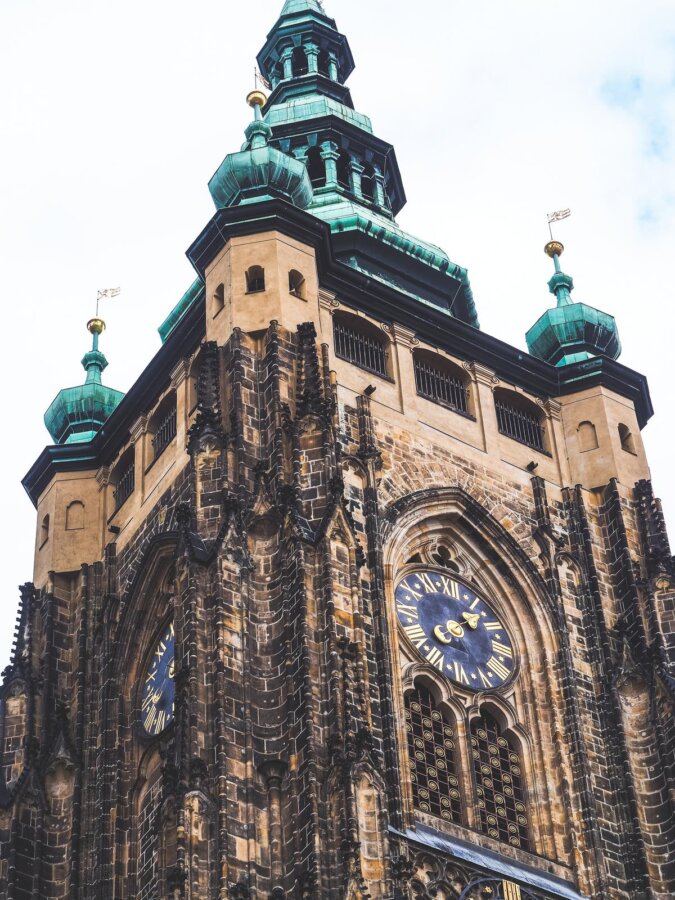
{“en”: “St Vitus Cathedral stands as the crown jewel of Prague Castle and the most important Gothic church in the Czech Republic. Taking nearly 600 years to complete (1344-1929), this architectural masterpiece combines French Gothic, Renaissance, and Art Nouveau elements. The cathedral houses the tombs of Bohemian kings and Holy Roman Emperors, while the stunning St Wenceslas Chapel glitters with semi-precious stones and houses the Crown Jewels behind seven locks. The 96.5-meter Great South Tower offers breathtaking views after climbing 287 steps, and the interior dazzles with exceptional stained glass windows including Alfons Mucha’s famous Art Nouveau masterpiece depicting Czech patron saints.”}
Cultural Context
St. Vitus Cathedral is deeply embedded in the cultural and spiritual life of the Czech Republic, serving as a symbol of national identity and religious tradition. It hosts significant religious ceremonies, including the coronations of Bohemian kings and queens, underscoring its role in the intertwining of faith and monarchy. The cathedral is a focal point during major Christian celebrations such as Easter and Christmas, where liturgical rites are observed with solemnity and grandeur. Additionally, it is a repository of Czech cultural heritage, reflecting centuries of artistic patronage, including stained glass windows designed by renowned Czech artists like Alfons Mucha. The cathedral also plays a role in contemporary cultural events, hosting classical music concerts that celebrate Czech composers. Local customs often involve pilgrimages to the cathedral, particularly to venerate the tomb of St. John of Nepomuk, a national saint whose story is integral to Czech religious folklore. The cathedral’s presence in Prague Castle complex makes it a living part of daily cultural expression, where tradition and modernity coexist in the ongoing narrative of Czech history and spirituality. Thus, St. Vitus Cathedral is not only a religious site but a vibrant cultural institution that continues to inspire and unify the Czech people through its enduring traditions and celebrations.
Historical Context
The historical significance of St. Vitus Cathedral spans nearly a thousand years, with its origins dating back to 1344 when construction began under the reign of King John of Bohemia. The cathedral was intended to serve as the main church of the Kingdom of Bohemia and a coronation site for its monarchs. Its construction was overseen initially by the French architect Matthias of Arras and later by Peter Parler, whose innovative designs shaped much of the cathedral’s Gothic character. Throughout its history, the cathedral witnessed key historical events, including the coronation of Charles IV in 1347, who was instrumental in promoting Prague as a cultural and political center of Europe. The building process was interrupted multiple times due to wars, political upheavals, and financial difficulties, with completion only achieved in the 20th century, in 1929. The cathedral has survived periods of religious conflict, including the Hussite Wars in the 15th century and the secularization under communist rule in the 20th century. It also contains the tombs of important historical figures such as St. Wenceslaus, the patron saint of Bohemia, and Emperor Charles IV. The cathedral’s layered history reflects the complex evolution of Czech statehood, religious practice, and artistic achievement, making it a monumental testament to the region’s rich past.