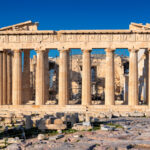
The Temple of Olympian Zeus (Olympieion) is one of the most colossal temples of the ancient world, dedicated to Zeus, king of the Olympian gods. Though its construction began in the 6th century BCE under the Athenian tyrants, the temple was only completed some 638 years later by Roman Emperor Hadrian in 132 CE. Originally featuring 104 towering Corinthian columns, each rising to 17 meters in height, today just 15 remain standing—with a 16th column having fallen and still lying where it collapsed during a storm in 1852. The temple’s massive footprint (approximately 108 by 41 meters) and the grandeur of its remaining columns convey the extraordinary scale of this once-magnificent structure. Located in a spacious archaeological park near the National Garden, the site offers spectacular views of the Acropolis and creates a striking contrast between the temple’s classical proportions and the contemporary Athens skyline. The Olympieion is a powerful testament to both ambitious ancient architectural vision and the passage of time.
Cultural Context
The Temple of Olympian Zeus holds profound cultural significance as a symbol of ancient Greek religious devotion and the embodiment of divine authority. Dedicated to Zeus, the king of the Olympian gods, the temple was a focal point for worship and ritual practices in Athens, reflecting the central role of mythology and religion in Greek daily life. The temple’s construction and eventual completion spanned several centuries, mirroring the evolving cultural and political landscapes of ancient Greece. It was not only a place of worship but also a monumental statement of power and piety, illustrating the Athenians’ reverence for Zeus as the protector and ruler of the cosmos. Throughout history, the site served as a venue for religious festivals and ceremonies, including offerings and sacrifices intended to secure the favor of the gods. The cultural resonance of the Olympieion extends into modern times, where it stands as a testament to the enduring legacy of ancient Greek spirituality and its influence on Western cultural and religious traditions. Visitors today can appreciate the temple not only as an archaeological marvel but also as a cultural landmark that offers insight into the spiritual life and values of ancient Athens. The temple’s presence continues to inspire respect for the rich tapestry of Greek mythology and its impact on cultural identity across millennia.
Historical Context
The Temple of Olympian Zeus in Athens has a complex and extended historical background that spans over six centuries. Its initial construction began in the 6th century BCE during the rule of the Athenian tyrants, who envisioned a grand temple surpassing all others in magnificence. However, the project was halted for several centuries due to political turmoil and financial difficulties. It was not until the reign of the Roman Emperor Hadrian in the 2nd century CE that the temple was finally completed, around 132 CE. Hadrian, a known philhellene, sought to honor Greek culture and religion by finishing this monumental structure, which had remained incomplete for generations. The temple’s history reflects the shifts in political power, from Athenian autonomy to Roman imperial influence, illustrating the broader historical transitions in the region. Over time, the temple suffered damage from invasions, earthquakes, and the repurposing of its materials during the Byzantine and Ottoman periods. Despite this, the ruins remain a powerful historical symbol of Athens’ ancient glory and its integration into the Roman Empire. The temple’s long construction period and its completion under Roman patronage highlight the blending of Greek and Roman histories, marking it as a significant historical landmark that encapsulates centuries of architectural ambition and cultural evolution.