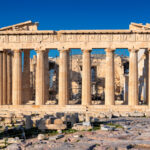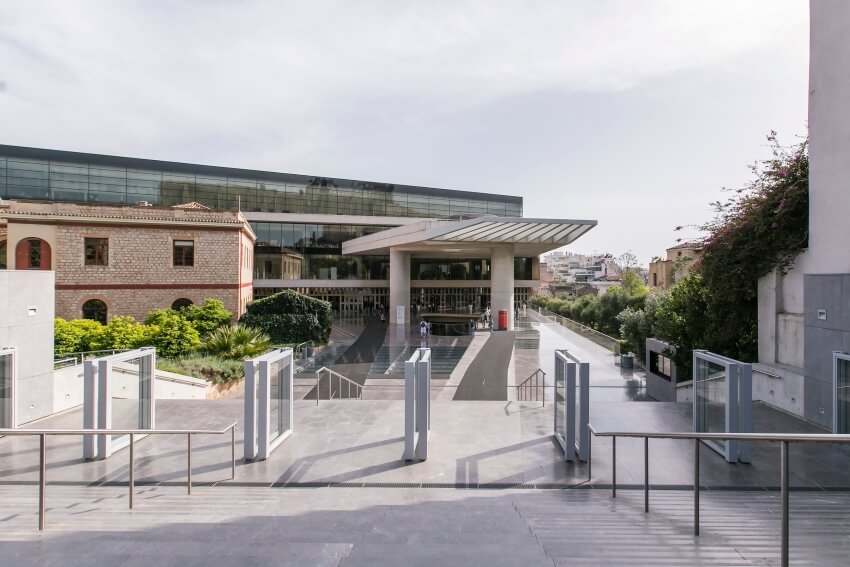
The Acropolis Museum in Athens is a world-class archaeological museum designed to house the artifacts discovered on the Acropolis and its slopes. Opened in 2009 and designed by architect Bernard Tschumi, the modern glass and concrete structure creates a direct visual connection to the Acropolis itself, which can be viewed from the museum’s top floor. The museum’s exhibition space spans 14,000 square meters across four levels, thoughtfully organized in chronological order, from prehistoric finds to Roman antiquities. Among its most treasured holdings are original sculptures from the Parthenon, Caryatids from the Erechtheion (with one space left empty to highlight those still held in the British Museum), and the magnificent Archaic gallery featuring colorful kouroi and korai statues. The museum’s top floor follows the exact dimensions of the Parthenon, allowing visitors to view the famous frieze in its original configuration while maintaining a visual connection to the temple itself through expansive glass walls.
Cultural Context
The Acropolis Museum stands as Athens’ most significant cultural institution, designed specifically to showcase the archaeological treasures of the Acropolis within sight of their original context. Opened in 2009, this world-class museum represents Greece’s determination to provide a worthy home for the Parthenon sculptures and other artifacts, while making a pointed statement about the return of the Elgin Marbles still held in the British Museum. The museum’s cultural importance extends beyond preservation – it serves as a bridge between ancient glory and modern Greek identity, allowing visitors to understand how the sacred rock shaped Western civilization. Bernard Tschumi’s revolutionary design creates dialogue between antiquity and modernity, using natural light and transparent walls to display sculptures as the ancient Greeks intended. The museum functions as both archaeological repository and political statement, with empty spaces deliberately left for the missing Parthenon sculptures, transforming absence into powerful cultural commentary. Through innovative exhibition design, the museum contextualizes artifacts within their original architectural and religious framework, helping visitors understand the Acropolis not just as ruins but as a living sacred space. The institution has become central to Athens’ cultural tourism, educational programs, and national pride, demonstrating how contemporary museum design can enhance rather than overshadow ancient heritage while advocating for cultural repatriation.
Historical Context
The Acropolis Museum’s history reflects Greece’s long struggle to properly house and display its most precious antiquities. The need for a new museum became urgent in the 1970s when the old 19th-century museum on the Acropolis proved inadequate for conservation needs and visitor numbers. Initial plans in 1976 faced decades of delays due to archaeological discoveries, design controversies, and political changes. An international architectural competition in 1989 selected Italian architects Manfredi Nicoletti and Lucio Passarelli, but their design was abandoned after archaeological remains were discovered on the proposed site. A second competition in 2000-2001 selected Bernard Tschumi’s design, which brilliantly solved the challenge of building over an active archaeological site. Construction from 2003-2007 revealed an entire ancient Athenian neighborhood beneath, which Tschumi incorporated into the design through glass floors and an accessible excavation level. The museum opened on June 20, 2009, amid international acclaim and renewed calls for the return of the Parthenon Marbles from London. The building itself makes a historical statement – its Parthenon Gallery precisely mirrors the temple’s dimensions and orientation, with empty spaces awaiting the sculptures’ return. This architectural activism transforms the museum from passive repository to active participant in ongoing cultural heritage debates, embodying Greece’s assertion that the Parthenon sculptures belong in Athens, visible from their original home.