Carved over eons, Utah’s landscapes are a testament to nature’s artistry, providing a haven for those who seek adventures or wish to bask in the tranquility of natural magnificence. The unique attractions shaped by the forces of the earth have long been recognized and protected by parks to preserve them.
Utah’s national parks are collectively called the Mighty Five – a big name that’s well deserved. They are Arches, Canyonlands, Capitol Reef, Zion, and Bryce Canyon, and each presents a distinct aspect of Utah’s scenic splendor. But beyond these, dozens more hidden gems are scattered around the state in the form of state parks, tribal parks, national monuments, and other protected lands.
Those who revel in the outdoors will find no shortage of activities, from trekking and mountain biking to discovering ancient dwellings and millennia-old cultures. Sometimes, a scenic drive through these stunning places is all you need.
Each of the Mighty Five is a unique experience and should be visited by nature lovers, while their lesser-known counterparts offer fewer crowds and similarly breathtaking scenery. If any of the five Utah national parks are on your bucket list, we highly recommend looking through our guide below to see what kind of other treasures you can hit simultaneously.
Best Parks in Utah to Visit
If you plan to hit multiple Utah parks on your trip, one of the America the Beautiful Passes can save you a ton of money, as they work across agencies at more than 2,000 sites nationwide. It might even be free.
And don’t go on this type of outdoorsy trip without travel insurance – our favorite providers include VisitorsCoverage and World Nomads.
1. Zion National Park

Zion National Park is one of Utah’s most popular parks due to the stunning, unworldly red rock formations and the incredible hiking trails. April to October is the best time to visit Zion regarding weather. However, note that the Zion Canyon Scenic Drive, the most popular part of the park, is closed to private vehicles during these months – access is via shuttle bus instead, as this helps with overcrowding.
The diverse scenery in Zion National Park stems from deep, colorful canyons carved by the Virgin River. Massive cliffs, valleys, ridges, and slot canyons create the scenes for some of Utah’s best hiking and scenic driving. Here are just a few of the top things to experience in Zion:
- The Narrows: One of the park’s most popular hikes, it follows the river along the canyon floor, including some wading, through narrow passages between cliffs.
- The Emerald Pools: This trail is more family-friendly. It has paved surfaces leading to Lower Emerald Pool, which has beautiful colors and scenery.
- Angels Landing: The views from the top of this popular hike are incredible, but it’s a serious workout.
- Canyon Overlook: A short but moderately difficult trail to take you to a spot high above the deep canyons without a long-distance trail.
- Kolob Terrace Road: Drive this route through the much more remote northern part of the park to get off the beaten path.
There are plenty of hotels near Zion National Park, most directly beside the park entrance, where shuttle service is available. Check out places like these in the local town of Springdale:
- Budget: Holiday Inn Express Springdale
- Mid-Range: Best Western Zion Park Inn
See Related: Things to Know Before Going to Zion National Park
2. Coral Pink Sand Dunes State Park

Coral Pink Sand Dunes State Park is one of Utah’s best parks. It’s closer to Las Vegas than Salt Lake City and less than an hour from Zion National Park. The rolling pink-colored dunes are great for all sorts of activities, but the most popular is photography.
The dunes’ color comes from the pinkish-red Navajo Sandstone cliffs surrounding the area, which erode in high winds. Tiny pieces blow into the dunes. While admiring the landscape from the observation deck is magnificent, other extreme activities include off-roading on the dunes, renting ATVs, and even sandboarding.
You can stay in the local town of Kanab if you aren’t day-tripping in from Zion, and there’s a nice Holiday Inn Express & Suites there. Kanab is a good place to stay for a night or two if you also want to see the southern part of the Grand Staircase-Escalante National Monument – more on that later.
3. Bryce Canyon National Park

Bryce Canyon National Park is an otherworldly place best known for its hoodoos. These unique rock formations were created over time by erosion, making for a landscape like no other.
The best way to experience Bryce Canyon is to hike through it, and there are trails appropriate for everyone from beginners to experts. Of course, scenic drives through the park are also spectacular. But you choose to see the sights, consider hitting these big ones:
- The Rim Trail: This trail takes you along the edge of the Bryce Amphitheater, offering stunning views of the hoodoos below.
- Sunrise Point & Sunset Point: If you’re in the park at the beginning or end of the day, these are great places to be, thanks to amazing colors and shadows.
- The Fairyland Loop Trail: This trail is a bit more challenging but takes you through some of the park’s most beautiful parts.
- The Queens Garden Trail: This is a shorter and easier trail that takes you to some of the most popular hoodoos in the park.
The best choice is to stay in Bryce Canyon City, directly outside the park’s entrance. There are a handful of campgrounds and accommodations in the town, but two major hotels stand out and should be your primary choices:
- Mid-Range: Ruby’s Inn
- Luxury: Best Western Plus Bryce Canyon Grand Hotel
See Related: Where to Stay in Bryce Canyon
4. Kodachrome Basin State Park

Kodachrome Basin State Park is another beautiful place to visit in southern Utah. Just 30 minutes from Bryce Canyon, it’s an easy add-on to a trip there and reveals even more unique geography found nowhere else. The park is best known for its stunning red rock formations and panoramic views.
The park has 67 spire-like hollow sand pipes, and scientists disagree on exactly how they came to be. A leading argument is that they were once geysers, like those found in Yellowstone, that eventually solidified. Hiking, picnicking, and camping can’t be done anywhere else.
Horseback rides through the park are also possible. Staying after dark isn’t a bad idea, as this area has very little light pollution, making stargazing incredible. There are a few small inns, vacation rentals, and campsites in the local town of Cannonville, but you can easily stick to the same accommodations as Bryce Canyon.
5. Arches National Park

Arches National Park is one of the most popular tourist destinations in Utah. The park has over 2,000 natural sandstone arches and various other geological formations. It’s located in the remote eastern part of Utah near the little town of Moab.
The best time to visit Arches National Park is from April to October, when the weather is warm and dry and is ideal for hiking. But the park is impressive even during winter, when the snow-capped rocks, Ice Age fossils, and formations create a unique and otherworldly landscape.
[viatravelers_360_image_pannellum image=”https://viatravelers.com/wp-content/uploads/360-images/park-avenue-arches-national-park-360.jpeg”]
Whenever you go, consider these spots to visit:
- The Fiery Furnace: An up-close view of the red cliffs and fascinating formations on a rugged loop hike.
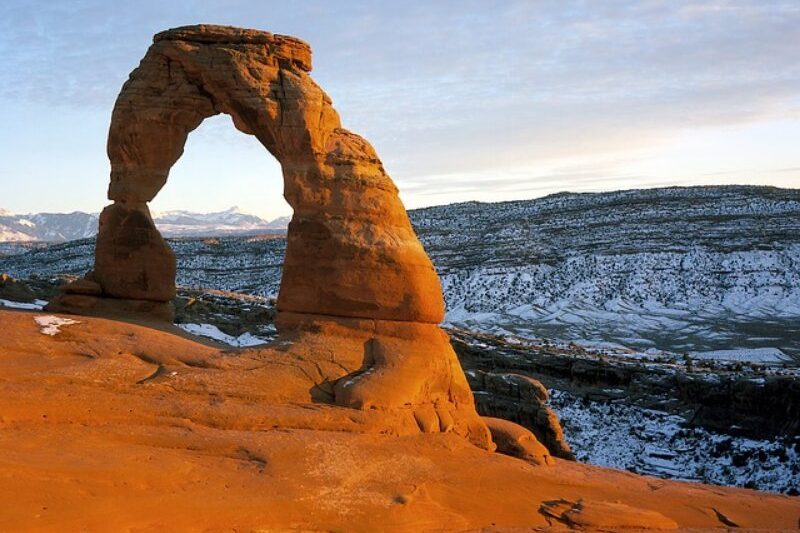
- The Delicate Arch Viewpoint: From this vantage point, you’ll get a stunning view of the Delicate Arch, one of the most iconic symbols of Utah.
- The Windows Section: This part of the park is home to some of the most beautiful views in Arches National Park, like giant windows to the other side. Don’t miss North and South Windows on their trail.
- Balanced Rock: Just beside the road to The Windows, this tall column perfectly balances a big boulder at its top; this is a quick stop you shouldn’t miss.
- The Devil’s Garden: This semi-difficult trail leads to the park’s northernmost arches, including the famous Landscape Arch, the park’s largest.
Fun fact: Mesa Arch, another of Utah’s most famous and most photographed, is not in Arches National Park but in the nearby Canyonlands National Park (up next). Luckily, it’s quite close and easily visited from the town of Moab. These are some of the best places to stay there:
- Budget: Wingate by Wyndham Moab
- Mid-Range: La Quinta Inn & Suites Moab
See Related: Where To Stay In Moab, Utah: Best Areas & Places
6. Canyonlands National Park

Canyonlands National Park is just 30 minutes south of Arches. The park surrounds the Green River, the Colorado River, their tributaries, and the magnificent canyons they’ve shaped. Besides hiking and associated activities, the Canyonlands are a popular destination for rafting and kayaking.
The park has four “districts” with unique attributes and individual attractions. You can decide to focus on certain districts or individual places and activities based on the time you have:
- Island in the Sky District: This is the most accessible and popular part of the park, with major attractions like the Green River Overlook, the Mesa Arch, the Grand View Point, and beautiful spots overlooking the Orange Cliffs.
- Needles District: A bit further south from Island in the Sky, this part of the park is more rugged and is named for the sandstone spires that cover the landscape.
- Maze District: This western park corner is the most rugged, requiring an off-road-capable vehicle and good backcountry skills.
- Horseshoe Canyon District: It’s the smallest district and separated from the rest of the park, but you can find fascinating rock markings from ancient peoples here, plus more of that great scenery.
If you don’t have much time or want an easy, scenic drive with stopping points, stick to Island in the Sky. Most of the park’s iconic vistas, including Mesa Arch, are along the road. Accommodation options for Canyonlands are also in Moab.
7. Dead Horse Point State Park

Dead Horse Point State Park is an easy and excellent addition to a visit to Canyonlands and Arches. It occupies a portion of cliffs and canyons just before the entrance to Canyonlands and offers more stunning views of the Colorado River’s creations.
The legend behind Dead Horse Point’s name is that cowboys rounded up wild mustangs on the naturally advantageous point, surrounded by cliffs on all sides and with a narrow entrance. For whatever reason, a herd was left there and did not survive the exposure. Besides this somewhat ominous past, it’s a beautiful place!
There are a variety of activities to enjoy at the park, including hiking, biking, and camping. On a clear day, you can see for miles in all directions; by night, the park is one of the best stargazing spots in Utah. Again, look to Moab for accommodations.
See Related: Where Should I Travel for My Birthday?
8. Capitol Reef National Park

Last but certainly not least, one of Utah’s national parks is Capitol Reef. This remote park is in central Utah, sort of in between the other four, and the nearest population center is the small town of Torrey. Capitol Reef National Park is known for its stunning red rock cliffs and canyons and its abundance of wildlife.
The domes, cliffs, natural bridges, and other scenery result from a 100-mile-long wrinkle in the earth called the Waterpocket Fold. The park’s name comes from two phenomena: the white sandstone formations that look like the white domes found on buildings in the Capitol and the rugged terrain known as “reef” here. These are some of the park’s top attractions:
- The Scenic Drive: It only takes 90 minutes to enjoy the park from the road. There are many opportunities to stop off, hike, and take pictures, especially at Panorama Point.
- Capitol Gorge Trail: An all-around great choice for anyone, passing petroglyphs, name carvings of western pioneers, steep canyon walls, and beautiful scenery.
- Cathedral Valley: As long as your car has higher-than-average clearance, you should be able to take on this rugged section of the park, where towering rock formations look like cathedrals rising from the dust.
- Hickman Natural Bridge: This is a 133-foot-long natural bridge with an impressive canyon and cliff surroundings, and there’s a short, easy hike around it.
- Sulphur Creek: This nearly 6-mile trail goes through a narrow gorge and almost always flows with water, sometimes high enough to require swimming.
The park is also home to some of the most extensive petroglyphs in North America from the Fremont people who once lived in the area. Here are some places to base yourself while you see it all:
- Budget: Motel Torrey
- Mid-Range: Broken Spur Inn & Steakhouse
9. Goblin Valley State Park

Goblin Valley State Park is one of Utah’s most unique and visually stunning parks (which says a lot). The park is located in the San Rafael Swell and is best known for its extraordinary Goblin-like rock formations, which are actually interestingly shaped hoodoos.
Hiking and biking are two of the most popular activities in the park, as numerous trails wind through the picturesque landscape. Camping and stargazing are also great, but photography of the unique hoodoos is best during the day. The Goblin Overlook is a good place to get a panoramic view.
Goblin Valley is about an hour and a half from Torrey and Moab. It is within potential day trip distance from Capitol Reef National Park, Arches National Park, and Canyonlands National Park. There’s not much else in between, so look to those places for accommodation.
See Related: Cheap Places to Travel
10. Antelope Island State Park

Antelope Island State Park is one of the easiest outdoor havens to reach from the state’s capital, Salt Lake City. It’s also the best place to appreciate the Great Salt Lake from which the name comes.
Antelope Island is not an island but a large peninsula jutting into the Great Salt Lake. The Antelope Island Causeway is the only way in, and this narrow road stretches from the “mainland” across the water, as there is no access from the land side of the peninsula. The visitor center is a great place to start after you make the crossing.
Hiking and biking trails are abundant and may follow the lakeshore or ascend the interior heights. Paddleboarding and kayaking are great lake activities, as is swimming – the salty water makes you extra buoyant!
11. Sand Hollow State Park

Located in Hurricane, Utah, Sand Hollow State Park offers a serene escape into the wild. The park boasts a stunning reservoir, inviting visitors to dive into its waters, cast a line for fishing, or navigate its expanse by boat. You can rent water toys around the park or from providers in Hurricane.
For those who prefer land-based adventures, many trails are perfect for trekking or cycling through the scenic landscape. To the reservoir’s south, a vast, gently sloping rock face is a local favorite for off-roading. Rent a four-wheeler or take a professionally driven tour in one to beat around the rugged terrain.
Hurricane and the nearby town of St. George are small cities popular with tourists, and you’ll find plenty of dining, activities, and accommodations in this part of Utah. Zion National Park isn’t far either, and these areas are popular for combined use. Here are some of the best hotels near Hurricane and St. George:
- Budget: Wingate by Wyndham Hurricane/Zion National Park
- Mid-Range: TownePlace Suites by Marriott St. George
See Related: Day Trips from Salt Lake City, Utah
12. Snow Canyon State Park

Another great destination in the area, just north of St. George, is Snow Canyon State Park, home to many different landscapes and geologic phenomena. Hiking, biking, or horseback riding can take you to petrified dunes, lava tubes, caves, and much more.
There’s a scenic overlook that requires no hiking and makes for great photos. But the best views are revealed on a trail like Lava Flow or Jenny’s Canyon. The park is home to wildlife, including deer, rabbits, and lizards.
It rarely rains in this part of southern Utah, so you can leave your umbrella at home. However, the sun gets extremely hot in the summertime, so don’t go far without a good hydration pack and some sunscreen.
13. Cedar Breaks National Monument

Cedar Breaks National Monument is a compact but beautiful park located near the town of Cedar City. Like Bryce Canyon, this national monument is centered around a natural amphitheater that plunges a half-mile deep – at more than 10,000 feet elevation.
Because of that elevation, snowfall usually makes it inaccessible between October and May, and the visitor center is closed during that period. There are just a handful of hiking trails in and around the amphitheater, including beginner-friendly ones, but you’ll want to get altitude-acclimated before even easy activity. Bring along some Boost Oxygen Canisters if you’re worried about that.
If you want to stay in lovely Cedar City, a convenient stop on a pan-Utah road trip, there’s a nice Courtyard by Marriott right beside the highway. You could also make this a day trip from your accommodation near Zion or Bryce Canyon, which are 1.5 hours and 1 hour away.
See Related: Things to Do in St. George, Utah
14. Goosenecks State Park

Goosenecks State Park spans over 4,000 acres in San Juan County, southeastern Utah, and is renowned for its dramatic, winding canyons. Since its creation in 1996, the park has drawn visitors with its remarkable series of meandering bends in the San Juan River, aptly named the Gooseneck.
Notable geological landmarks include the panoramic Goosenecks Overlook and the striking Mexican Hat Rock Formation. After dark, the area is under a canopy of stars, perfect for astronomy enthusiasts.
This is a remote part of Utah, so you may need to stay a night nearby – the Hat Rock Inn is one of the only options in the nearby town of Mexican Hat. If you choose to do so, take advantage of being just 30 minutes away from Monument Valley Navajo Tribal Park, just over the border in Arizona. It’s another breathtakingly beautiful preserve that is perfect for adding to a great outdoor trip to Utah (even if it’s not in Utah).
15. Natural Bridges National Monument

The Natural Bridges National Monument is also near the southeastern corner of Utah. It’s about an hour’s drive north of the aforementioned town of Mexican Hat and the same distance from the slightly larger Monticello. Three natural sandstone bridges are the main attractions, and the surrounding area has generally lovely scenery.
Natural bridges are created by water flow that continuously erodes rock until the stream breaks through and flows underneath the structure it created. Visitors can take Bridge View Drive, the scenic byway through the monument, to catch views of all three, and various hiking trails lead down to their bases.
Mexican Hat, as discussed above, is a great place to base yourself to see this national monument, Goosenecks State Park, Monument Valley, and even the Four Corners Monument. But you can also stay at one of the small inns of Monticello, like the Inn at the Canyons, if you’d rather be closer to towns like Moab and the Needles District entrance of Canyonlands.
See Related: How to Pack For a Camping Trip
16. Flaming Gorge National Recreation Area

Now, to the extreme northeast of Utah, you’ll find Flaming Gorge National Recreation Area straddling the state’s border with Wyoming. This place is known for its stunning red rock cliffs and excellent fishing opportunities in the Flaming Gorge Reservoir, which is the center of this preserve. Those red rocks give the gorge its “flaming” name.
The reservoir is a popular spot for boating and fishing, and the park has a few boat ramps and marinas. Paddleboarding and kayaking are also great activities, along with rafting down certain portions of the river. The hiking trails offer stunning views of the gorge, especially from above, and the camping sites are well-equipped and spacious.
There is no major town near Flaming Gorge, but there are several boutique hotels and inns around it, like the Flaming Gorge Resort. Campsites are also abundant.
17. Grand Staircase Escalante National Monument

Occupying a whopping 1.7 million acres of south-central Utah, Grand Staircase Escalante National Monument is known for its stunning scenery and abundance of outdoor activities. The vastness of this preserve encompasses most of the types of terrain and geologic features found in the state, including canyons, deserts, rivers, and forests.
There are just a few paved roads that cross the outskirts of the monument, and something a bit more rugged will be required to access its interior. That could be a 4×4, a four-wheeler, an ATV, or a horse. You could always hike into Grand Staircase Escalante, but be sure you have the right hiking equipment – especially a good backpack and pair of shoes.
This monument is gigantic, so there are many options for accommodations around it. If you’re saving up for the trip of a lifetime, look to the ultra-luxe Amangiri Resort, as you won’t find anything else like it.
However, you could also choose to stay across the border in Page, Arizona, and spend a few days here, allowing you to see multiple other parks.
You can enjoy water sports on Lake Powell, take a Navajo-led tour of Antelope Canyon (perhaps the most famous slot canyon in the country), and maybe even escape to the lesser-visited North Rim of the Grand Canyon.
See Related: Things to Do in Provo, Utah
18. Dinosaur National Monument

Last but not least is Dinosaur National Monument, located on the Colorado-Utah border. The monument is world-renowned for its dinosaur fossils, dating back to the Late Cretaceous period. Most are found in Dinosaur Quarry, which lies on the Utah side.
Dinosaurs once roamed the rocky landscapes and mountains of this area, and after they died, their remains were carried by the Yampa and Green Rivers to the Dinosaur Quarry. The specific type of sandstone that accumulated around them preserved everything beautifully for us to find all these years later. Many of the relics are on display in an exhibition hall.
The monument also offers several educational programs about geology, paleontology, and history. Petroglyphs are scattered around the rocks. The main town to stay in is Vernal, which has a Hampton Inn & Suites.
FAQ
How many parks are there in Utah?
There are 5 Utah national parks and 46 state parks and recreation areas, all diverse and unique. Expanding your trip to the border areas of states around Utah reveals even more nature preserves and parks that make great additions to a Utah vacation.
What is the most famous park in Utah?
Many visitors consider Zion National Park the best national park in Utah. But that is very subjective – while Zion’s red cliffs and deep canyons are stunning, other parks in Utah have towering hoodoos, natural arches and bridges, lava tubes, colorful dunes, and much more.
Related Resources