Ever wondered how long it would take to travel around the world? The short answer depends entirely on what you travel in. Flying the 24,901-mile circumference at a widebody jet’s typical 560 mph cruise is roughly 44 hours in the air. The fastest sailboat ever to lap the planet non-stop took 40 days. A record-setting solo aircraft did it in 67 hours. Walking it takes about four years. Here is what each mode actually costs you in time, with the records that set the ceiling.
Long-term travel is a dream for many who are stuck in the 9-5 grind. However, if you’re one of the lucky ones who have the opportunity to book a one-way ticket to explore the world, it’s a gratifying experience.
Traveling around the world is by no means easy. You would need to list the places you want to visit, along with your expenses and duration of stay in each location.
But arguably, one of the biggest questions you may have before you depart on your adventure is how long it would take to travel around the world.
If you’ve watched the movie or read the book Around The World in 80 Days, you’ll know there are countless ways to get from one place to another – each with its time frame. Here’s a map of how it was done.
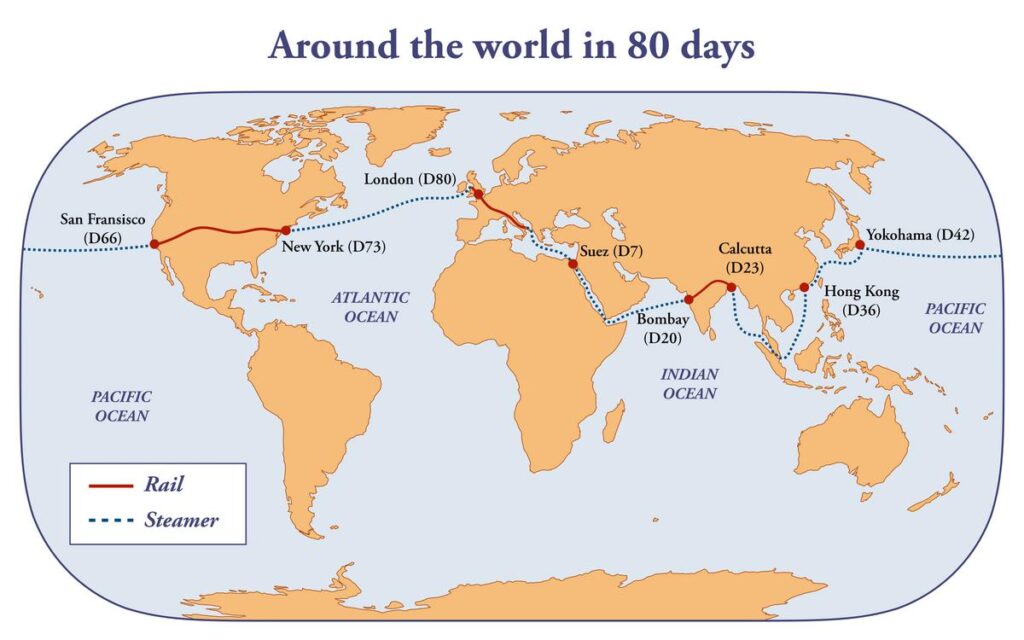
How Long Does a Trip Around the World Take by Each Mode?
| Mode | Fastest documented | Realistic trip |
|---|---|---|
| Commercial flying | About 44 hours of flight time (24,901 miles at 560 mph) | 2 to 4 weeks with stops |
| Private aircraft, non-stop | 67 hours 1 minute (Virgin Atlantic GlobalFlyer, 2005) | Not open to the public |
| Sailing, non-stop | 40 days 10 hours 45 minutes (Sodebo Ultim 3, 2026) | 3 to 5 years cruising |
| Rail plus short flights | Not a record category | About 60 days on a packaged tour |
| Driving with sea crossings | Not a record category | 3 to 4 months |
| Walking | 4 years (Steven Newman, 1983 to 1987) | 4 years and up |
Seeing the entire world in one trip is incredibly appealing for a world explorer. If you’ve ever been curious about an around-the-world adventure, we’ve broken down the best ways to make the journey by different modes of transportation, be it a car, plane, or boat.
How Long Does It Take To Travel Around The World?
Long-term travel allows you to explore the city beyond its tourist attractions and immerse yourself in the local culture. If traveling worldwide is a bucket list item for you (as it is for many of us), here’s how long it takes to explore Mother Earth.
See Related: Why Traveling is Important
Fly Around the World

The most common way to get from one place to another is by aircraft. But while you may travel a couple of hours at a time to get from your destination to the next, some people may choose to fly across the entire world at a single time. However, the way to do that will not be by commercial aircraft.
This could be to break a world record or just for the thrill. The arithmetic is simple enough to check yourself: the Earth measures 24,901 miles around the equator, and a modern widebody cruises at roughly 560 mph, so a theoretical non-stop lap is about 44 hours in the air. That figure is the floor. It ignores headwinds, the fuel stops any airliner would need, and the fact that no scheduled route flies a straight line around the equator.
However, this number could vary depending on factors like the type of plane, the number of stops, and the place of departure. Traveling worldwide by plane with no refuels may sound impossible, but various pilots have attempted it before.
The Rutan Voyager flew the first non-stop, non-refueled lap of the planet in December 1986. American pilots Dick Rutan and Jeana Yeager left Edwards Air Force Base on December 14 and landed there again on December 23, covering an official 24,986 miles in 9 days, 3 minutes and 44 seconds – an average of about 116 mph. They landed with roughly five gallons of usable fuel left. The aircraft now hangs in the Smithsonian National Air and Space Museum.
While this is an extensive period, thanks to improved technology, planes today can fly around the world much faster.
Nineteen years later the Virgin Atlantic GlobalFlyer, another Burt Rutan design, went one better: a solo lap. Steve Fossett flew it alone, non-stop and unrefueled, backed by Richard Branson.
Fossett took off from Salina, Kansas on February 28, 2005 and landed back there on March 3 after 67 hours and 1 minute, covering about 23,000 miles at an average 342.2 mph – the speed record the Federation Aeronautique Internationale still lists for a non-stop, non-refueled circumnavigation. A full round-the-world trip on a single non-stop flight remains impossible in a standard commercial aircraft, because no airliner carries that much fuel.
The longest scheduled passenger flight by distance is Singapore Airlines SQ23/SQ24 between Singapore and New York JFK, about 9,537 miles and roughly 18 hours 50 minutes on an A350-900ULR. By clock time the current title holder is different: since October 2025, Xiamen Air’s twice-weekly JFK to Fuzhou service is scheduled at 19 hours 20 minutes, because the airline routes around Russian airspace rather than through it. Either way, that is well over a third of the way around the planet in one leg.
The gap between those two record flights shows how fast the technology moved: Voyager needed nine days and a two-person crew in 1986, while GlobalFlyer needed under three days and one pilot in 2005.
What you can buy today is an around-the-world ticket from one of the airline alliances, which strings together a fixed number of segments in one continuous direction and is usually valid for up to a year. That is the practical version of the Voyager and GlobalFlyer flights: same loop, far more legroom, several months instead of several days.
See Related: How Much is a Trip to Italy: Average Cost Per Day
Take A Train

Although you can’t hop on a commercial flight to travel the entire world simultaneously, this mission is possible by train travel.
When it comes to traveling by train, many will tell you that the journey is more important than the destination. This could not be truer if you wanted to see the world by rail.
Traveling around the world by train sounds like something straight out of Murder on the Orient Express, and packaged versions of it do exist. Railbookers sells an Around the World by Luxury Train itinerary that runs 60 days across four continents and nine countries, stringing together eight named trains – among them the Rocky Mountaineer, the Royal Scotsman, the Venice Simplon-Orient-Express, the Maharajas’ Express, Rovos Rail and the Eastern & Oriental Express. Short flights bridge the oceans; everything else is on rails.
Itineraries in this category typically open in Europe or in London, fly to North America for a rail leg through cities such as Denver and Chicago, then cross the Pacific for the Asian and African segments.
Passengers will again need to fly to Shanghai for the rest of the trip, which will continue only by rail. The train in Shanghai takes travelers to Moscow with a detour in Mongolia.
The train returns to Europe from Russia and travels across cities like Vienna, Prague, and Venice. The trip ends in London again.
These are small-group, high-end products and they are priced accordingly – operators publish current fares on request rather than as a fixed list price, so check directly before you budget. What you are buying is the logistics: visas, transfers, baggage and berth reservations across a dozen rail operators, handled for you.
If you enjoy rail travel, there are a ton of great bucket-list train rides that offer wonderful experiences and will spur your travel inspiration.
Some of the longest train rides in the world include the Eastern and Oriental Express, the Indian Pacific, and the Blue Train. Each trip covers different regions across the world.
See Related: Where Should You Travel for Your Birthday?
Sail Around The World

Flying around the world may seem like the most obvious choice for many, but exploring new destinations on a boat comes with fewer logistical issues.
For one, you would not need to find accommodation in each city you visit. Different continents are linked to each other by water bodies, making sailing one of the easiest ways to travel to the Earth.
Cruising with stops takes years. Racing does not. On January 25, 2026 the trimaran Sodebo Ultim 3, skippered by Thomas Coville with six crew, crossed the Ushant to Lizard Point line after 40 days, 10 hours and 45 minutes at sea to take the Jules Verne Trophy – 28,315 miles sailed at an average 27.17 knots, and 12 hours 44 minutes faster than the IDEC Sport record that had stood since 2017. Racing solo in a monohull is slower: Charlie Dalin won the 2024-25 Vendee Globe in 64 days, 19 hours, 22 minutes and 36 seconds.
For everyone who is not chasing a trophy, cruising sailors sort the trip into three broad styles. The first is non-stop or near non-stop passage-making, which compresses the loop into months rather than years but leaves almost no time ashore.
The second type of sailing would be Express sailing, which is ideal for amateur sailors. This involves sailing for two days straight and then docking for a day at a time for food and provisions. This trip would take you 1-2 years.
The last type (probably the most common) is the recreational journey. Sailors will spend 5 days on land for every 1 day at sea. This gives you ample time to explore each destination at your own pace. Time is of the essence here as this journey can take 3-5 years.
Traveling by sea may come without the added burden of finding accommodation, but planning your journey takes a lot of time and preparation.
You must plan your route and the time spent at the dock while factoring in the weather and tide levels. But if you set your mind to it, exploring the world on a boat is possible.
See Related: Free Printable Travel Planner
Walk The Earth

If you consider yourself a true daredevil and, more importantly, have a lot of time on your hands, would you ever walk across the earth?
As crazy as it sounds, walking the circumference of the globe is actually possible. It is a feat that has been attempted by some.
The step counts come from the people who actually did it, and they do not agree, because the routes do not. Dave Kunst counted about 20 million steps and 21 worn-out pairs of shoes over 14,450 miles. Steven Newman counted roughly 40 million steps over 21,000 miles. Either way it is years of walking, not months.
Dave Kunst is the first person independently verified to have walked around the Earth. He set out from Waseca, Minnesota on June 20, 1970 with his brother John and a pack mule, walked to New York, flew to Portugal and continued east across Europe, the Middle East and Asia before finishing in North America on October 5, 1974 – 14,450 miles across 13 countries.
It was not a stunt without cost. In October 1972 bandits shot both brothers in the mountains of Afghanistan; John was killed and Dave survived by playing dead. After four months recovering he resumed from the exact spot where his brother died, walking on with another brother, Peter. The first documented solo walk came later: Steven Newman left Bethel, Ohio in April 1983 and got home in April 1987.
Newman covered about 21,000 miles in those four years, collecting a signature in every town he passed through as proof, and Guinness recognized the walk in its 1988 edition. He set out with a pledge never to ask for more than a drink of water, and stayed with more than 400 families along the way. Walking the earth is possible, then, but it takes years of endurance and months of preparation before the first step.
Nevertheless, exploring the world on foot in any city or country you visit is an experience that remains unmatched by any other. Taking on a new place on foot lets you immerse yourself in the local culture and meet new people. You may find the world is more connected than you think.
As they say, the journey is more important than the destination.
See Related: Best Travel Purses
Take The Long Road
Taking the road less traveled is a phrase you hear often, but traveling around the world in a car would take this line literally. Cars have revolutionized how we get from one place to another, making it faster and easier to get from one point to the next.
A cross-country road trip is very common, but this journey across continents and oceans would take this to a new level. Logistically, it is impossible to travel the entire circumference of the earth by car because of the oceans and seas that separate continents.
However, if you load your car onto a ship between countries, the journey would take 3-4 months. This wholly depends on various factors, like the number of stops along the way and the type of car you are driving.
If you don’t want to change your mode of transport between places, some of the most common overland routes include Istanbul to Cairo, London to Palermo, and Cairo to Cape Town.
Nevertheless, traveling worldwide by road is the most economical way to save money. It also requires much less planning and allows you to remain flexible with your time.
Before you travel between countries by car, you can start by taking road trips within your country to get acclimated to life on the road. This can help you plan for any potential obstacles you may come across in your world travels.
See Related: Cheapest Places to Fly Around the World
Why You Should Consider a Trip Around the World
Traveling worldwide (if you have the liberty to do so) is an incredibly gratifying experience. You learn about different cultures and people, which can help expand your perceptions of our world.
If you strongly believe that traveling is more about the journey than the destination, your chosen vehicle plays a huge role in your trip.
Although travel times may vary, each transport mode offers its unique experience. We hope this article on how long it takes to travel the world inspires you to take a different mode of transport on your next trip.
See Related: Ways to Book the Cheapest First Class Flights
FAQ
How much does it cost to travel around the world?
If you go the cheapest route possible, it would cost around $30,000 to take an around-the-world trip. The biggest factor when planning how much to budget for your trip is how long you want to be gone. Costs will also vary depending on how luxurious a way of traveling you want or how cheap a way of traveling each individual prefers.
It’s up to each one to research and find what they prefer amongst these different categories in location, transportation, lodging, and activities to keep their desired budget intact while staying within their comfort zone physically and mentally.
How long does it take to fly around the world?
About 44 hours of flight time. The Earth is 24,901 miles around at the equator and a modern widebody cruises near 560 mph, which works out to roughly 44 hours in the air – before any of the fuel stops a scheduled aircraft would actually need.
How long would it take to drive around the world?
It would take you around 415 hours (more than 17 days) to drive the 24,900 miles around the earth’s circumference if you could drive a car around it. However, since you can’t drive a car around the earth, driving around the world would take much longer.
How many days would it take to travel around the world?
Traveling worldwide will take about three months if you visit several destinations along the way. If you want to travel the world as fast as possible, a trip could be accomplished in about 40 days.
What is a trip around the world called?
It’s called circumnavigation. It’s a challenge that many people attempt to achieve using a variety of methods, which entails navigating the total distance of the Earth’s circumference.
How long does it take to travel around the world on foot?
About four years, based on the only two verified walks. Dave Kunst covered 14,450 miles between June 1970 and October 1974, and Steven Newman covered roughly 21,000 miles between April 1983 and April 1987 – about 40 million steps.
Related Product Guides
- 7 Minimalist Travel Backpacks
- Best TSA Approved Luggage Locks
- Best Gifts for Couples Who Love Travel
Related Resources