MenuClose

A place worth knowing

Alexanderplatz

Historical landmarks · Square in GermanyUpdated

  • Google rating4.3/5 (230,000 reviews)
  • Typical visit1-3 hours average visit (longer if visiting TV Tower, shopping at Alexa, or enjoying seasonal markets)
  • EntranceFree
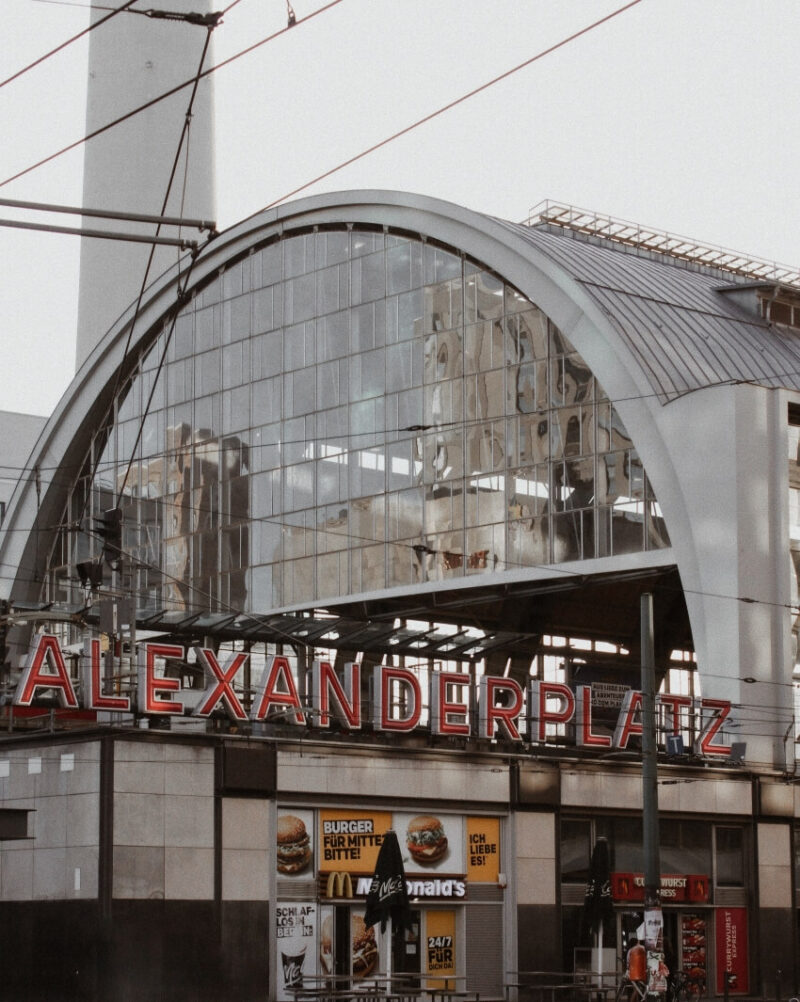
Curve Glass Roof with "Alexanderplatz" written on it Side
  • Today (Thursday)Open 24 hours
  • Typical visit1-3 hours average visit (longer if visiting TV Tower, shopping at Alexa, or enjoying seasonal markets)
  • EntranceFree
  • Google rating4.3/5 230,000 reviews
  • WebsiteOfficial site ↗
  • TicketsCheck availability ↗
Opening hours all week
Monday
Open 24 hours
Tuesday
Open 24 hours
Wednesday
Open 24 hours
Thursday
Open 24 hours
Friday
Open 24 hours
Saturday
Open 24 hours
Sunday
Open 24 hours
Curve Glass Roof with "Alexanderplatz" written on it Side
The short answer

Why it matters

Berlin's most prominent public square in Mitte, dominated by the 368-metre Fernsehturm (TV Tower), the World Clock (Weltzeituhr), and major transit connections — a Cold War-era focal point now ringed by shops and hotels.

  • Universal Appeal and Cultural Authenticity (80/100): Alexanderplatz is a globally recognized square often described in literature and film, contributing to its universal appeal. Its cultural authenticity shines through its daily life and activities that attract a mix of both locals and tourists, reflecting authentic urban German culture.
  • Cultural Richness and Educational Value (70/100): The square provides a rich educational experience due to its historical significance and the impact depicted through Berlin’s diverse urban narratives. However, its commercial aspects sometimes overshadow the deeper cultural and educational layers.
  • Preservation and Integrity (85/100): While there are ongoing debates about the redevelopment of Alexanderplatz, efforts to maintain its historical integrity are evident. The area incorporates both historical and modern elements, reflecting Berlin’s complex past and its rapid development, which speaks to effective preservation but also reflects the challenges of maintaining authenticity amidst modernization.
  • Accessibility and Visitor Engagement (90/100): Alexanderplatz scores high on accessibility and visitor engagement, featuring excellent public transport connectivity and a plethora of activities that engage visitors with its vibrant atmosphere. The array of shops, eateries, and cultural events makes it a lively spot that’s easily enjoyed by a diverse audience.

Alexanderplatz stands as Berlin’s most intriguing urban palimpsest, where each historical era has imposed its vision upon this vast public square in the heart of the former East Berlin. Originally a medieval cattle market outside the city walls, “Alex” (as locals affectionately call it) transformed into a military parade ground under Prussian rule before becoming a vibrant transportation hub and commercial center in the early 20th century, immortalized in Alfred Döblin’s 1929 novel “Berlin Alexanderplatz.” The square’s most dramatic makeover came during the German Democratic Republic period when East German authorities reimagined it as a socialist showcase with monumental structures including the 365-meter Fernsehturm (TV Tower), the modernist Weltzeituhr (World Clock) that displays time zones globally, and uniform concrete high-rises exemplifying socialist urban planning. Today’s Alexanderplatz presents a fascinating collision of preserved socialist architecture, contemporary commercial developments, transit infrastructure, and impromptu cultural performances where street musicians, political demonstrators, and seasonal markets create a dynamic public forum. Unlike more picturesque European squares, Alexanderplatz offers something more complex—an honest architectural record of Berlin’s fractured history where each building and monument tells part of the city’s story. The square continues evolving with ongoing construction projects, maintaining its historical role as the place where Berlin publicly manifests its current identity while preserving fragments of its complicated past for authentic urban exploration.

Cultural Context

Alexanderplatz embodies Berlin’s complex identity as a city repeatedly destroyed and reimagined, where each historical layer reveals competing visions of urban life and political ideology. Known affectionately as “Alex” by Berliners, this vast square serves as the city’s most democratic space – neither beautiful nor refined, but authentically representative of Berlin’s fractured history. The square’s socialist redesign in the 1960s created a showcase for GDR urban planning, featuring monumental structures like the Fernsehturm and Weltzeituhr that proclaimed East Germany‘s technological ambitions. Unlike picturesque European squares, Alexanderplatz offers something more profound – an honest architectural chronicle where medieval market, Prussian parade ground, Weimar-era commerce, socialist monumentality, and capitalist redevelopment collide without resolution. The square functions as Berlin’s crossroads in every sense: transportation hub where U-Bahn, S-Bahn, trams, and buses converge; social melting pot where tourists, locals, street performers, and protestors share space; and cultural forum where political demonstrations, Christmas markets, and spontaneous gatherings animate the vast concrete expanse. The preserved GDR elements amid ongoing construction create a uniquely Berlin aesthetic of perpetual incompletion. Today’s Alexanderplatz continues its historical role as the stage where Berlin publicly negotiates its identity, making it essential for understanding how cities process trauma, division, and reunification through urban space.

Historical Context

Alexanderplatz’s history mirrors Berlin’s transformation from medieval town to divided Cold War city to reunified capital. Originally the Ochsenmarkt (cattle market) outside the medieval walls in the 13th century, the square gained its current name in 1805 honoring Tsar Alexander I’s visit to Berlin. The 19th century saw its evolution into a major commercial hub, with department stores, markets, and transit connections making it the heart of working-class Berlin. Alfred Döblin’s 1929 novel “Berlin Alexanderplatz” immortalized the square’s Weimar-era vibrancy as a chaotic crossroads of modern urban life. World War II bombing raids devastated the area, leaving ruins that East German planners saw as opportunity for radical reimagining. The 1960s socialist redesign under architects Werner Dutschmann, Erhardt Gißke, and Roland Korn created today’s vast pedestrian space, eliminating traditional street patterns for monumental scale. The 365-meter Fernsehturm (1965-1969) proclaimed GDR’s technological prowess, while Erich John’s Weltzeituhr (1969) symbolized international solidarity. The square witnessed pivotal moments: the 1989 demonstration of 500,000 protesters demanding democratic reforms helped precipitate the Wall’s fall. Post-reunification development has added shopping centers and hotels while preserving key GDR monuments, creating ongoing tension between preservation and modernization. Current redevelopment plans by architect Hans Kollhoff envision high-rise towers, sparking debates about erasing or embracing socialist heritage in the 21st-century city.

Context

Story and significance

About

Alexanderplatz, the historic heart of Berlin, is a mesmerizing symphony of the past and the future. Once a humble market square, it has risen from the ashes of war to become a bustling epicenter adorned with modern marvels. The towering 365-meter TV Tower punctuates the skyline, offering breathtaking panoramic views of the city’s mosaic of history and modernity.
Here, history whispers in the cobblestones while contemporary life bustles around. Alexanderplatz is not just a space; it’s a crossroads of culture, history, and innovation. Visitors leave with a profound sense of Berlin’s resilience and a yearning to delve deeper into its vibrant soul.

Historical significance

Alexanderplatz is historically significant as a long‑standing commercial and transport center shaped by imperial, wartime, socialist and contemporary urban policies. It has been the site of political demonstrations and social change, making it important to urban historians and to Berliners as a symbol of shifting public life and governance.

Historical context

Named for a Russian tsar in the 19th century, Alexanderplatz rose as an important commercial and transport center in imperial and Weimar Berlin, was heavily bombed in World War II, and was redesigned under East German planning as a wide, open public space with large public buildings. Its post‑reunification years brought further redevelopment and modernization while traces of GDR urbanism remain.

Cultural context

Alexanderplatz is a central, multifunctional square that serves as a transport nexus and a lively urban meeting place for shopping, markets, street performances and civic gatherings. For residents it’s an everyday hub and for tourists a gateway to nearby museums, shops and panoramic views from surrounding towers.

Architecture

The square is framed by a mix of architectural layers: late 19th‑century buildings, large East German era concrete structures and later modern high‑rises like the TV tower and office blocks. The Fernsehturm (TV Tower) is the dominant vertical landmark visible across the city, exemplifying 1960s modernist state architecture and engineering prominence.

Local significance

Alexanderplatz is a long‑standing civic and commercial heart of East Berlin whose name evokes both everyday routines and public gatherings for many locals. It serves as a major transit hub and meeting place, surrounded by shops, offices and informal street life, so Berliners often reference it when arranging appointments or celebrating city events. For many residents it carries layers of history — from imperial times through GDR-era planning to contemporary urban change — that shape neighborhood identity.

Editorial scores

How we rate it

Universal appeal & authenticity10/10
Cultural richness & educational value10/10
Preservation & integrity10/10
Accessibility & visitor engagement10/10

Editorial scores on a 10-point scale, judged against places of the same kind.

Bookable experiences

Worth booking ahead in Germany

Hand-picked from the operators our guides already send readers to. Prices and availability are live on the partner site.

We earn a commission if you book through these links, at no extra cost to you. It is how we keep the guides free and independent.

Updated Data: Editorial research · Google Places ratings · Verified coordinates