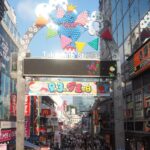
Tokyo‘s Shibuya Scramble Crossing represents the perfect urban spectacle – possibly the world’s busiest pedestrian intersection where up to 3,000 people simultaneously cross in all directions when traffic lights change. Located directly outside Shibuya Station, this famous “scramble” creates a hypnotic choreography of urban movement against a backdrop of massive video screens, neon advertisements, and the iconic Shibuya 109 building. The crossing gained international fame through appearances in films like “Lost in Translation” and countless travel features symbolizing Tokyo’s organized chaos. During peak hours, the intersection completely empties of vehicles, filling instead with a perfectly orchestrated flow of pedestrians who navigate the space with remarkable efficiency before the lights change. Observation points in surrounding buildings, particularly the Starbucks overlooking the crossing and the newer Shibuya Sky observatory, offer breathtaking views of this uniquely Japanese urban phenomenon that embodies the city’s harmonious blend of high-density living, technological sophistication, and social order.
Cultural Context
Shibuya Scramble Crossing is a vibrant symbol of contemporary Japanese urban culture, embodying the dynamic energy and fast-paced lifestyle of Tokyo. It serves as a daily convergence point for thousands of pedestrians, reflecting the collective rhythm and orderliness that characterize Japanese society. The crossing is often featured in media and popular culture, representing the epitome of modern city life and the intersection of tradition and innovation. It is not only a transit hub but a cultural icon where locals and visitors alike experience the unique social choreography of crossing together in waves, demonstrating Japan’s emphasis on harmony and respect within crowded public spaces. Seasonal events and festivals in the nearby Shibuya district, such as Halloween celebrations and New Year’s gatherings, often spill into the crossing area, reinforcing its role as a communal space that supports cultural expression and social interaction. The crossing’s proximity to youth culture hubs, fashion centers, and entertainment venues further amplifies its significance as a locus of Tokyo’s evolving cultural trends and urban identity. Visitors can observe how the crossing functions as a living stage for the city’s cultural narrative, blending everyday routine with vibrant public life, making it a powerful cultural landmark in Tokyo.
Historical Context
The area around Shibuya Scramble Crossing has a rich historical background that dates back to the early 20th century when Shibuya began emerging as a key commercial and entertainment district. The crossing itself gained prominence after the installation of the first scramble pedestrian light in the late 1970s, a novel traffic management innovation that allowed pedestrians to cross in all directions simultaneously. This change transformed the intersection into a symbol of modern urban planning and efficiency. Historically, Shibuya evolved from a post-town in the Edo period into a bustling metropolitan center following Japan’s rapid industrialization and urban expansion in the 20th century. The crossing witnessed significant transformations during the post-war reconstruction era, reflecting Tokyo’s resilience and growth. Over the decades, it has been a silent witness to the city’s shifting social and economic landscapes, from the bubble economy of the 1980s to the present-day global metropolis. The crossing’s development parallels Tokyo’s rise as a center of innovation, culture, and commerce, marking it as a historically significant urban node that encapsulates the city’s modernization trajectory. Today, it stands as a testament to Tokyo’s continuous adaptation and the historical layering of urban life in one of the world’s most populous cities.