MenuClose

A place worth knowing

Deoksugung Palace

Historical landmarks · Palace in SeoulUpdated

  • Google rating4.2/5 (18,000 reviews)
  • Typical visit2-3 hours (longer if attending guard ceremony or visiting the art museum)
  • Entrance₩1,000
Seoul palace with city skyline at sunset, iconic Korea travel destination
Seoul Palace at Sunset (Kyle Kroeger / ViaTravelers)
  • Today (Thursday)9:00 AM – 9:00 PM
  • Typical visit2-3 hours (longer if attending guard ceremony or visiting the art museum)
  • Entrance₩1,000
  • Google rating4.2/5 18,000 reviews
  • WebsiteOfficial site ↗
Opening hours all week
Monday
9:00 AM – 9:00 PM
Tuesday
Closed
Wednesday
9:00 AM – 9:00 PM
Thursday
9:00 AM – 9:00 PM
Friday
9:00 AM – 9:00 PM
Saturday
9:00 AM – 9:00 PM
Sunday
9:00 AM – 9:00 PM
Accessibility
"{"parking": "Limited parking available. Accessible parking spaces near main entrance. Drop-off zone available.", "mobility_info": "Main paths are paved and mostly level. Some areas have gravel or uneven stones. Rest areas with benches throughout. Maps indicate accessible routes.", "public_transport": "City Hall Station (Lines 1 & 2) has elevator access. Exit 2 closest to palace entrance. Buses stop nearby.", "wheelchair_access": "Main areas wheelchair accessible with ramps at major buildings. Some traditional thresholds may require assistance. Stone paths can be uneven.", "accessibility_services": "Wheelchair rental available at information center. Accessible restrooms throughout complex. Braille signage at major buildings.", "sensory_considerations": "Changing of guard ceremony includes drums and music. Peaceful gardens offer quiet spaces. Audio guides available in multiple languages."}"
The short answer

Why it matters

Seoul's only palace blending Western neoclassical and Korean traditional architecture, with evening openings, a royal guard ceremony, and a romantic stone-wall path.

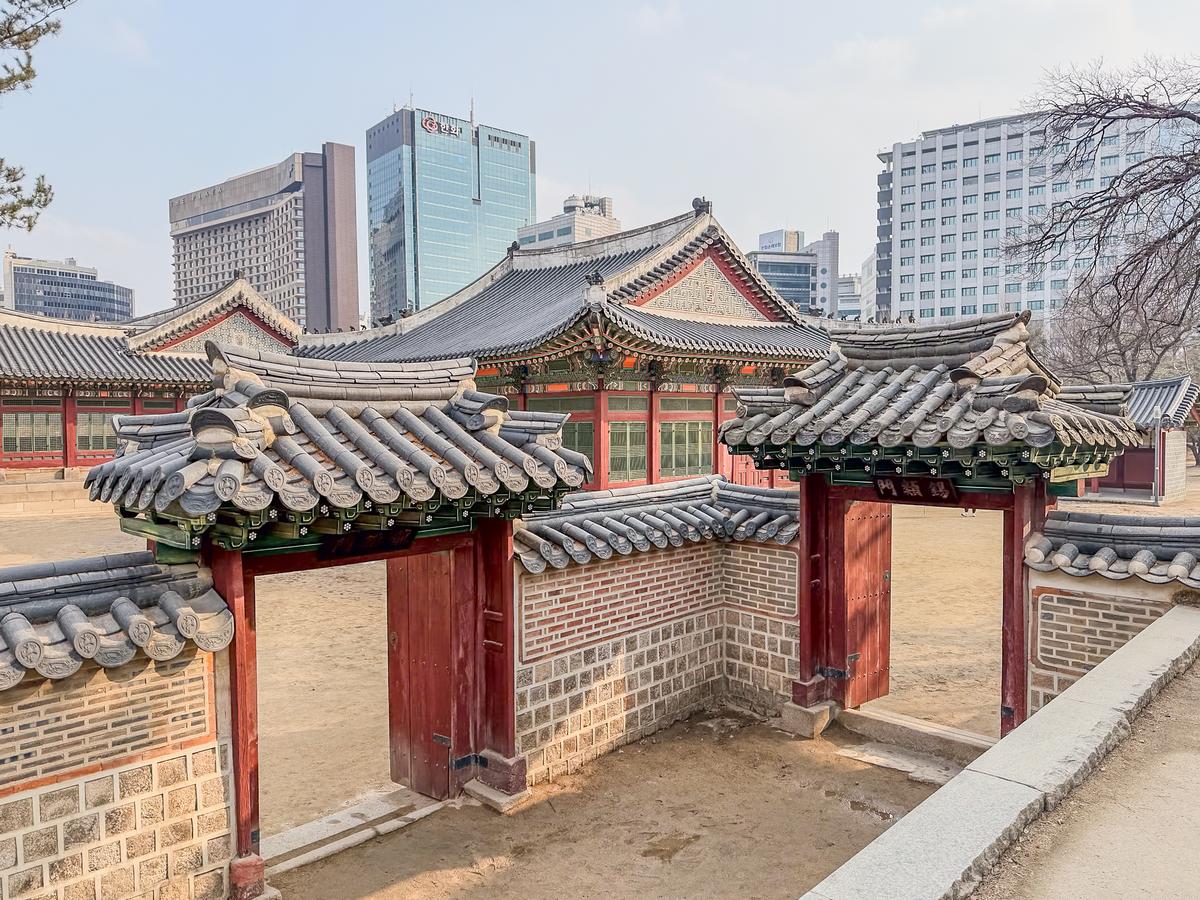
Distinguished by its unique architectural fusion, Deoksugung Palace stands at central Seoul‘s bustling City Hall intersection as a tranquil historic enclave amid skyscrapers. Originally a prince’s residence, it became an imperial palace during the tumultuous late Joseon period when King Gojong took refuge here after the 1895 assassination of his wife Queen Myeongseong and ruled until 1907. Unlike Seoul’s other royal palaces, Deoksugung features a remarkable blend of traditional Korean structures alongside Western-style stone buildings—most notably Seokjojeon Hall, designed by British architect G.R. Harding in the neoclassical style, reflecting Korea’s early modernization efforts and complex relationship with Western powers. The changing of the guard ceremony resurrects Joseon Dynasty traditions with colorful regalia and synchronized movements, while the palace’s small but exquisite gardens—particularly beautiful during spring cherry blossom season—offer contemplative views framed by centuries-old stone walls. The adjacent modern art museum housed in a former imperial library creates additional dialogue between traditional culture and contemporary expression, making Deoksugung an embodiment of Korea’s transition from isolated kingdom to modern nation.

Cultural Context

Unique palace blending Korean tradition with Western modernity reflecting late Joseon Dynasty’s struggle between isolation and modernization, symbol of Korea’s tragic imperial period and cultural adaptation under pressure

Historical Context

Originally prince’s residence becoming palace 1611 under Gwanghaegun, main palace during 1897-1910 Korean Empire under Emperor Gojong, site of forced abdication 1907, renamed Deoksugung meaning virtuous longevity

Context

Story and significance

About

Deoksugung Palace is a Joseon-era royal compound in the heart of Seoul surrounded by modern skyscrapers, uniquely blending Korean traditional architecture with Western-style neoclassical buildings added during the Korean Empire period (1897–1910). Emperor Gojong lived here during Korea’s final years of sovereignty, and the Seokjojeon stone hall was the first Western-style building in a Korean palace. The palace is especially beloved for the 900-metre Deoksugung Doldam-gil (Stone Wall Path) along its exterior, a tree-lined promenade popular for romantic walks beneath ginkgo trees. A royal guard changing ceremony takes place three times daily.

Historical significance

Deoksugung Palace holds profound historical significance as one of the five grand palaces of the Joseon Dynasty and as a symbol of Korea’s transitional period during the late 19th and early 20th centuries. Originally the residence of Prince Wolsan, the palace became a royal residence for King Gojong in 1897 after the destruction of Gyeongbokgung Palace during the Imjin War and subsequent political upheavals. It was at Deoksugung that King Gojong declared the Korean Empire, elevating his status from king to emperor in an effort to assert Korea’s sovereignty amid increasing foreign pressures, particularly from Japan and Russia. The palace thus became the political and cultural center during a turbulent era marked by modernization attempts and colonial encroachment. Despite suffering damage during the Japanese occupation, Deoksugung remained a symbol of Korean resilience and national identity. The palace grounds witnessed significant historical events, including royal ceremonies, diplomatic receptions, and the eventual abdication of Emperor Gojong in 1907. Today, Deoksugung serves as a poignant reminder of Korea’s struggles for independence and modernization, reflecting the complexities of its late Joseon and Korean Empire periods. Its preservation and ongoing public access ensure that visitors can engage deeply with Korea’s layered history and appreciate the legacy of its royal heritage within the context of modern Seoul.

Historical context

Originally prince’s residence becoming palace 1611 under Gwanghaegun, main palace during 1897-1910 Korean Empire under Emperor Gojong, site of forced abdication 1907, renamed Deoksugung meaning virtuous longevity
Cultural context

Unique palace blending Korean tradition with Western modernity reflecting late Joseon Dynasty’s struggle between isolation and modernization, symbol of Korea’s tragic imperial period and cultural adaptation under pressure

Architecture

Only Korean palace combining traditional architecture with Western buildings including Seokjojeon Hall and Jeonggwanheon coffee pavilion, famous stone-wall road creates romantic urban atmosphere unique among Seoul palaces

Local significance

Downtown Seoul oasis amid modern buildings at busy intersection, popular for romantic stone-wall walks, houses Daehan Empire History Museum and National Museum of Modern Art branch, accessible palace for urban visitors

Experience

Make the most of it

Local tips
  • Free entry on national holidays
  • Architecture tours focus on details
  • Gardens often free to explore
  • Evening tours show different atmosphere
  • Special events throughout the year
  • Local guides share best stories
  • Best visited during shoulder season
Hidden gems nearby
  • Original features behind newer additions
  • Original graffiti from centuries ago
  • Hidden rooms discovered during restoration
  • Rooftop access for special tours
  • Underground passages and cellars
  • Archaeological finds displayed in basement
  • Secret gardens not on main tour
Special features
  • Deoksugung Palace is renowned for its distinctive architectural fusion that combines traditional Korean palace structures with Western neoclassical and Renaissance styles. This unique blend is most evident in the Seokjojeon Hall, a Western-style stone building constructed in 1905, which contrasts strikingly with the wooden pavilions and gates typical of Joseon Dynasty palaces. The palace grounds are notable for their well-maintained gardens, stone walls, and the iconic Deoksugung Stone Wall Road, which is a popular scenic pathway lined with ancient trees and historic walls. Additionally, the palace hosts the Changing of the Royal Guard ceremony, a vibrant reenactment of Joseon-era royal military traditions that attracts many visitors. Deoksugung's compact layout, nestled amidst Seoul's modern cityscape, offers a serene atmosphere that highlights the juxtaposition of Korea's historical heritage and contemporary urban life. The palace also houses several important cultural assets, including the Junghwajeon Hall, the main throne hall, and the Jeonggwanheon Pavilion, which was used for royal tea ceremonies and diplomatic receptions. These features collectively make Deoksugung a remarkable site where visitors can experience a tangible connection to Korea’s dynastic past alongside the influences of early 20th-century modernization efforts. The palace’s accessibility and central location contribute further to its appeal as a cultural and historical landmark in Seoul.
Editorial scores

How we rate it

Authenticity9/10
Accessibility score9/10
Family-friendly score8/10
Off-the-beaten-path4/10

Editorial scores on a 10-point scale, judged against places of the same kind.

Updated Data: Editorial research · Google Places ratings · Verified coordinates